Ever felt like work keeps coming, priorities keep changing, and your to-do list never ends? Many teams face this daily, which is why Agile ways of working are so popular. Understanding Kanban vs Scrum helps bring order to the chaos while improving focus and delivery.
In this blog, we explain what Kanban is, what Scrum is, their key differences, and similarities to help you choose the right approach through Kanban vs Scrum. Let’s get started.
What is Kanban?
Kanban is a visual Project Management approach used to track tasks and reduce inefficiencies. Work is displayed on a Kanban board, where tasks move through columns that represent different stages until completion, making progress easy to see.
By clearly showing what is being worked on and where delays occur, Kanban improves transparency, resource allocation, and delivery speed. It helps teams stay aligned with business goals while continuously improving workflow efficiency.
How to Measure Kanban Performance?
In Kanban, performance is measured by observing how smoothly work flows through the system. Rather than focusing on deadlines, Kanban uses data-driven metrics to ensure consistent and predictable delivery. The key metrics include the following:
1) Cycle Time
Cycle time measures how long a task takes to move from the moment work begins until it is completed. Shorter cycle times indicate smoother workflows, faster delivery, and help teams identify delays that affect overall efficiency.
2) Lead Time
Lead time tracks the total time from when a task is requested to when it is fully delivered. This metric helps teams understand system responsiveness, manage expectations, and improve how quickly value is delivered to customers.
3) Throughput
Throughput shows the number of tasks completed within a specific time period. Monitoring throughput helps teams measure productivity, understand delivery capacity, and plan future work more accurately and confidently.
4) Work In Progress (WIP)
Work In Progress measures how many tasks are being worked on at the same time. Limiting WIP prevents team overload, reduces bottlenecks, improves focus, and supports a steady and predictable workflow.
5) Cumulative Flow Diagram (CFD)
A Cumulative Flow Diagram visually represents how tasks move through each stage of the workflow over time. It helps teams spot bottlenecks, balance workloads, and maintain consistent delivery by clearly showing trends and flow patterns.

What is Scrum?
Scrum is an Agile methodology designed for managing complex projects that require frequent adaptation to change. It works through short development cycles called sprints, usually lasting one to four weeks, enabling regular planning, review, and improvement.
Scrum teams are small and self-organized, with defined job roles such as the Scrum Master and Product Owner. By delivering work in stages, Scrum supports flexibility, continuous feedback, and steady progress toward project goals.
How to Measure Scrum Performance?
In Scrum, progress is assessed by how well the team delivers on commitments made at the start of each sprint. Common metrics for measuring Scrum performance include:
1) Velocity
Velocity measures the amount of work a team completes during a sprint, usually in story points or hours. Tracking velocity helps teams understand their delivery capacity and make more accurate plans for future sprints.
2) Sprint Burndown Chart
A sprint burndown chart shows the remaining work in a sprint over time. It helps teams track progress daily, spot delays early, and stay focused on completing planned work before the sprint ends.
3) Sprint Goal Achievement
Sprint goal achievement measures whether the team successfully delivers the objective set at the beginning of the sprint. Meeting the sprint goal shows effective prioritization, collaboration, and delivery of meaningful value.
4) Defects and Quality
Defects and quality metrics track issues found during or after a sprint. Fewer defects indicate stronger development practices, better testing, and a higher-quality product that meets user and business expectations.
5) Team Satisfaction and Collaboration
Team satisfaction and collaboration reflect how well the Scrum team works together. Feedback from retrospectives highlights communication, morale, and process improvements that support long-term performance and continuous improvement.
Kanban vs Scrum: Differences
While Kanban and Scrum share common goals, their approaches to achieving them are quite different. To better understand these differences, let’s explore Kanban vs Scrum and see how each framework supports teams in its own way.
1) Structure
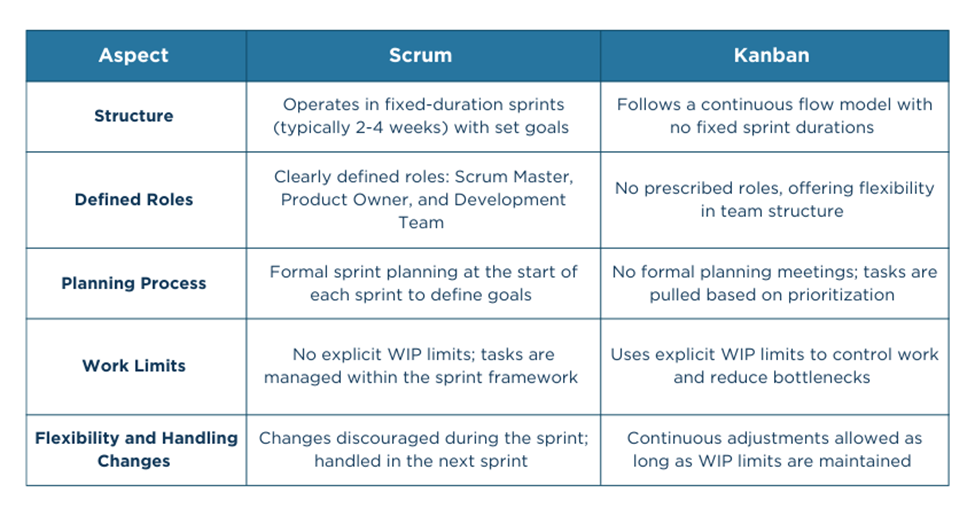
Scrum follows constant-duration sprints (typically 2-4 weeks) with set goals at the beginning of each sprint. Kanban, in evaluation, operates on a non-stop workflow, wherein tasks are pulled as potential allows, without fixed sprint durations.
2) Defined Roles
Scrum has clearly defined roles, including the Scrum Master, Product Owner, and the Development Team, each with specific responsibilities. Kanban, however, does not prescribe any specific roles, allowing more flexibility in team structure.
3) Planning Process
Scrum involves formal Sprint Planning at the start of each sprint to set goals and decide on tasks. Kanban doesn’t require formal planning meetings; instead, it focuses on continuous task prioritization with work pulled through the board based on capacity.
4) Work Limits
Kanban uses explicit Work In Progress (WIP) limits to control the amount of ongoing work, improving flow and reducing bottlenecks. Scrum typically does not impose WIP limits, as tasks are managed within the sprint framework and adjusted after each review.
5) Flexibility and Handling Changes
Scrum discourages changes during a sprint, as teams commit to a set of tasks for the sprint’s duration. Changes are considered in the next sprint. Kanban, on the other hand, allows for more flexibility, enabling continuous adjustments as long as WIP limits are maintained.
Master the skills to manage backlogs and deliver exceptional value by joining our
Scrum Product Owner Certification
. Today!
Kanban vs Scrum: Similarities
Before diving into the particulars of Kanban and Scrum, it’s essential to understand that those methodologies share several commonalities. Here are a few key areas where Kanban and Scrum align:
1) Both Follow Agile Principles
Kanban and Scrum are each grounded in Agile techniques that specialize in iterative progress, flexibility, and continuous improvement. They emphasize delivering cost incrementally rather than finishing the assignment all at once.
2) Workflow Visualization
Both frameworks make use of visible equipment to track tasks and monitor workflow. Kanban boards and Scrum forums offer visibility into the process, supporting groups discover present day obligations and capability bottlenecks; thereby guaranteeing transparency and accountability.
3) Emphasis on Team Collaboration
In each Kanban and Scrum, teamwork is prime to accomplishing objectives. Cross-purposeful groups are recommended to communicate overtly and collaborate to clear up issues and push responsibilities in the direction of completion.
4) Iterative Approach
While Scrum operates in time-boxed sprints and Kanban makes use of a continuous flow, each framework sells an iterative approach to projects. This enables groups to alter primarily based on remarks and training found out, improving their overall performance over time.
5) Commitment to Continuous Improvement
Both frameworks value regular reflection on processes and outcomes. Scrum achieves this through Sprint Retrospectives, while Kanban focuses on ongoing optimization by reviewing flow metrics and making adjustments accordingly.
Kanban Benefits and Drawbacks
Like any methodology, Kanban has its strengths and weaknesses that can influence its effectiveness. Here are some key pros and cons of using Kanban:
1) Benefits of Kanban
a) Gives a visual representation of the workflow, allowing for real-time tracking of progress
b) Maintains quality through Work In Progress (WIP) limits
c) Effectively manages the flow of the project
d) Creates feedback loops for continuous improvement
e) Enhances team collaboration
f) Allows for flexible adjustments based on priority
2) Drawbacks of Kanban
a) Lacks clearly defined responsibilities, which can make it challenging for teams to prioritize
b) It can become overly complex and confusing
c) Does not include specific timing parameters
Scrum Benefits and Drawbacks
Amidst its advantages, Scrum also comes with its own set of challenges based on your team’s dynamics and project needs. Below are some key pros and cons of using Scrum:
1) Benefits of Scrum
a) Provides a well-defined framework with roles, events, and artifacts
b) Frequent sprint reviews and retrospectives encourage continuous improvement
c) Time-boxed sprints help in delivering work at regular intervals
2) Drawbacks of Scrum
a) The structured approach can be inflexible for projects requiring frequent changes
b) Success heavily relies on the effectiveness of roles like Scrum Master and Product Owner
c) The numerous meetings and ceremonies can be time-consuming
Gain the expertise to excel in Agile projects – sign up for our
Scrum Developer Certification
now!
How to Decide Between Kanban and Scrum?
Choosing between Scrum and Kanban depends on your project type, team setup, and workflow. Understanding Scrum vs Kanban highlights how each approach works in practice. The points below can help you make the right choice:
1) Nature of Work
Scrum works best for projects with defined goals, planned deliverables, and regular feedback, such as product or Software Development. Kanban is better for continuous or unpredictable work, like support or maintenance, where tasks arrive at any time.
2) Team Structure and Roles
Scrum uses clearly defined roles, including the Scrum Master and Product Owner, which provide structure and accountability. Kanban does not require fixed roles, allowing teams to keep existing responsibilities and adapt roles naturally as work evolves.
3) Workflow Management
Scrum manages work through fixed-length sprints, focusing on completing a planned set of tasks within each cycle. Kanban focuses on visualizing workflow and maintaining a steady flow of tasks, without time-boxed iterations.
4) Flexibility and Adaptability
Scrum limits changes during a sprint, with adjustments usually planned for the next sprint. Kanban is more flexible, allowing new tasks or priority changes at any time, making it suitable for fast-changing environments.
5) Metrics and Improvement
Scrum tracks progress using velocity and burndown charts to plan future sprints. Kanban relies on flow-based metrics like cycle time and throughput to measure efficiency and support continuous, incremental improvement.
6) Project Complexity
Scrum is well suited for complex projects that need regular review, customer feedback, and iterative development. Kanban fits simpler or ongoing work that benefits from quick turnaround, visual tracking, and gradual process improvement.
Conclusion
Choosing the right Agile approach depends on how your team works, the type of tasks you handle, and how often priorities change. Understanding Kanban vs Scrum helps you align workflow, roles, and goals more effectively. By applying the right framework, teams can improve collaboration, delivery speed, and continuous improvement with confidence.
Lead your team to Agile success by signing up for our
Scrum Master Certification
now!


 Back
Back

 Topics

 Courses


 10 Aug 2026
 David Walter