Let’s say that you are excited to land a big client project. But now your team needs a reliable system to track tasks, share files, meet deadlines, and keep everyone on the same page. That’s when the big question hits: Basecamp vs Monday;
which one should you choose? It’s not just about flashy features; it’s about finding a tool that matches your team’s style and helps you deliver results without the hassle.
Maybe you need something straightforward like Basecamp, or maybe monday’s customizable boards are more your thing. Either way, the Basecamp vs Monday debate can feel overwhelming if you don’t know what really sets them apart. In this blog, we’ll explore the key differences, so you can make a smart, confident decision. After all, the right tool doesn’t just organize your work; it helps your team thrive.
Table of Contents
1) What is Basecamp?
2) What is monday.com?
3) Difference Between Basecamp and monday.com
4) Similarities Between monday.com and Basecamp
5) Best Use Cases for monday.com and Basecamp
6) Advantages and Disadvantages of Basecamp
7) Advantages and Disadvantages of monday.com
8) Conclusion
What is Basecamp?
Basecamp is a Cloud-based Project Management and team collaboration tool developed by 37signals. It helps teams manage tasks, share files, communicate, and track project progress in one place. The platform is known for its simple interface and easy-to-use design. It focuses on reducing complexity and improving team collaboration.
Basecamp is widely used by small and medium-sized teams to organize daily work and manage projects efficiently. It combines features like to-do lists, message boards, schedules, and file sharing within a single platform. The software follows a “less tools, more work” approach to keep Project Management simple and clear for teams.

Key Features of Basecamp
Basecamp offers a range of features that help teams manage projects and collaborate more effectively. Its simple interface allows users to organize tasks, communicate with team members, and track project progress in one place.
a) To-do Lists:
Create tasks, assign responsibilities, set deadlines, and monitor progress.
b) Message Boards:
Keep team discussions organized and accessible in one central space.
c) Schedules:
Plan timelines, deadlines, and important project events using shared calendars.
d) Docs & Files:
Store, share, and collaborate on documents and project files securely.
e) Campfire Chat:
Enable real-time group messaging for quick communication and updates.
f) Automatic Check-ins:
Collect regular progress updates from team members without meetings.
g) Client Access:
Share selected project details with clients for feedback and approvals.
h) Hill Charts:
Visualize project progress and track work stages more clearly.
What is monday.com?
monday.com is a cloud-based Work Management and Project Management platform designed to help teams organize and manage work efficiently. It allows users to plan projects, assign tasks, track progress, manage workflows, and collaborate in one central workspace. The platform is known for its visual interface and flexible project views.
monday.com is widely used by teams to manage projects, operations, marketing activities, and business processes. It offers features like dashboards, automations, timelines, Kanban boards, and integrations with third-party tools. The platform helps organizations improve visibility, communication, and productivity across teams.
Key Features of monday.com
monday.com offers a wide range of features that help teams manage projects, workflows, and daily operations more efficiently. Its visual and flexible interface allows teams to customize workflows based on their business needs.
a) Customizable Boards:
Organize projects, tasks, and workflows in a visual workspace.
b) Task Management:
Assign tasks, set priorities, track deadlines, and monitor progress.
c) Multiple Project Views:
View work through Kanban boards, timelines, calendars, charts, and tables.
d) Automation:
Automate repetitive tasks, notifications, and workflow processes.
e) Dashboards:
Track project performance and team productivity using real-time dashboards.
f) Collaboration Tools:
Share updates, comments, files, and feedback within tasks and projects.
g) Time Tracking:
Monitor time spent on tasks and improve Workload Management.
h) Third-Party Integrations:
Connect with tools like Slack, Google Drive, Microsoft Teams, and Zoom.
i) Reporting and Analytics:
Generate insights to support project planning and decision-making.
Difference Between Basecamp and Monday
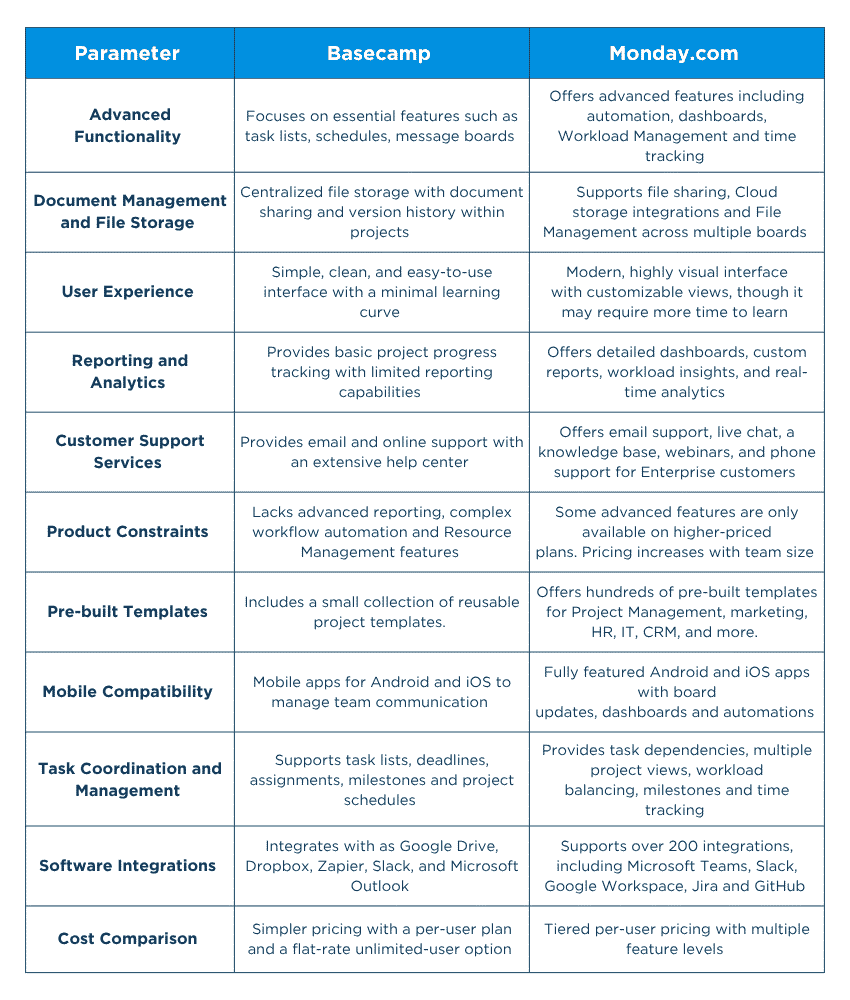
Basecamp makes it simpler for the user, making it easy to use and much user-friendly. It offers minimal design which makes it more straightforward. On the other hand, monday.com is more progressive and contributes to realistic visual techniques. It has a customizable working outlook that tailors the needs of the users. Let’s explore the key Basecamp vs Monday differences in detail:Here are some underlying distinctions between the two for your future reference:
1) Basecamp vs Monday: Advanced Functionality
Basecamp lacks advanced features that include time-tracing and Gannt charts. It promotes basic Project Management features and communication among the team members.
However, you can find a lot of modern elements on monday.com if you want a high-performance tool. It offers kanban boards, Gannt charts and automatic approaches. So, if you are looking for advanced commands, monday.com can be the one for you.
2) Basecamp vs Monday: Customization and Adaptability
When it comes to Basecamp, it adds limited personalization to the users. It is more straightforward and offers you a bare bones experience.
However, monday.com is immensely customizable and modified according to the user’s needs. It allows the users to adapt the tool to fulfil their project needs. It has visualization effects and custom dashboards to offer.
Master the tools behind successful projects – join our
Project Management Tools Training
now!
3) Basecamp vs Monday: User Experience
If you are looking for customization and visual interface, monday.com can be the best tool for your business. It has extensive personalization and modification features to offer.
But when it comes to Basecamp, it has a simple layout for the users that want simplicity and a clean workboard. Users can start their work quickly with the help of Basecamp making their work easier.
4) Basecamp vs Monday: Reporting and Analytics
Basecamp’s basic reporting features are focused on project updates, task progress, and team communication. It is designed to keep reporting simple and easy to understand.
monday.com provides more advanced reporting and analytics capabilities. It includes custom dashboards, visual project tracking, workload monitoring, performance metrics, and real-time data insights.
5) Basecamp vs Monday: Document Management and File Storage
When it comes to file storage and Document Management, Basecamp provides ample file storage options. It offers the users the chance to create and share their documents within the platform.
monday.com on the other hand offers measured file-storage. It depends on the subscription plans of the users. It also has a new Work Docs feature that helps you with Document Management. Based on these features you can easily choose which Project Management tool will be best for you.
Understand the Project Management principles with our
Asana Training
. Register today!
6) Basecamp vs Monday: Customer Support Services
Basecamp offers a flexible customer support service via chat or email to users. You can contact Basecamp’s customer support 24/7, Monday to Friday. You can also reach out to them at weekends from 9 am to 6 pm if needed.There is no phone support available for Basecamp.
monday.com allows 24/7 customer support for all the users with every plan type. It also includes free plan users. If you are an enterprise plan user, you can enjoy the extra advantage of getting a committed Customer Support Manager.
8) Basecamp vs Monday: Product Constraints
Basecamp and monday.com both offer a wide range of advantages but come with some limitations. Basecamp has a weakness of not having Kanban boards and Gantt charts that disappoints some of the users. If you are looking for a tool for complex teams then, Basecamp can be a total disappointment. Basecamp does not have time-tracking features, invoicing and Resources Management.
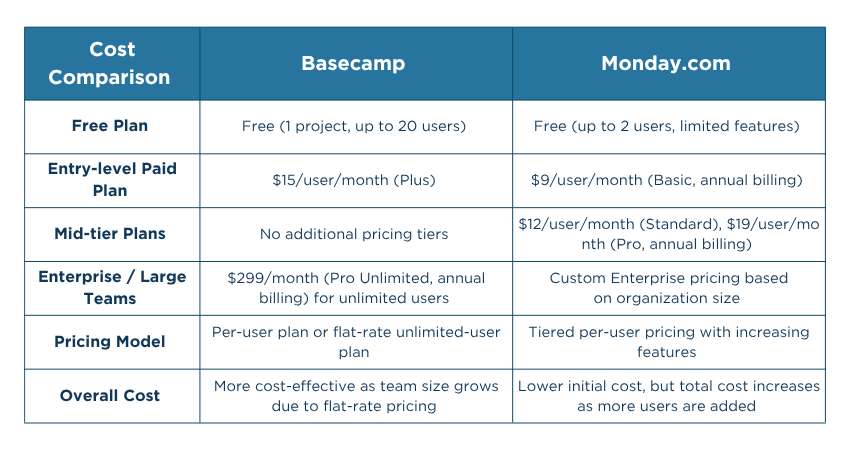
Conversely, monday.com has Kanban boards and Gantt charts with a time-tracking feature. However, it has limitations, such as costly plan types. Users have to pay a high price to enjoy the advanced features. Only the pro plan users can avail themselves of the time-tracking facility that starts from $19/month subscription.
monday.com is not a fit for huge organizations but for the small to medium sized enterprises and startups.
9) Basecamp vs Monday: Pre-built Templates
Basecamp deficits pre-built templates but you can create custom project templates to start a new project. On the other hand, monday.com is known for its customization ability thus offers an advantage of pre-made templates. You can use these templates to fit your projects and workflow.
Templates by monday.com include customer onboarding, social media campaigns, event planning, Campaign Management and more. Moreover, in a few clicks, you can transform your favorite boards into work templates.
Comment:
If you prefer making your own personalized templates, monday.com is the finest match.
10) Basecamp vs Monday: Streamline Workflows
monday.com offers out of the box automation in Workflow Management. It will be in your hands to customized workflow that fits your project. This idea is promoted by an automation builder that helps you build the same. The builder is very smart and automatic which allows you to build the automation on first go.
monday.com helps to automate the tasks that are repetitive in nature. Examples include status change, notification, replacing tasks with one another and so on. Quite the reverse: Basecamp does not have an automated feature. The tool offers automation via a third-party app.
11) Basecamp vs Monday: Mobile Compatibility
There is a similarity here when it comes to mobile versions of Basecamp and monday.com. Both come with their iOS and android app features making it easier for the Project Managers. Though mobile access comes with a handy advantage, for complex projects you have to rely on web apps or desktop.
There are not many distinctions between the two tools in terms of mobile compatibility. Both offer convenient mobile versions.
12) Basecamp vs Monday: Task Coordination and Management
Basecamp has a to-do list for each project and team for Task Management and coordination. Task lists are named accordingly with descriptions in which you can create your list and add tasks. Tasks cover up due dates, attachments, descriptions and others. It allows you to assign a task to multiple users and makes tasks repetitive.
Compared to the above tool, monday.com has various Task Management advantages. Some of them are dashboard, automation, time-tracking and board views. It makes the process easier in setting up tasks and subtasks. You can easily connect data to tasks like checklists, due dates, permissions and custom fields.
13) Basecamp vs Monday: Software Integrations
There is an interesting name of the Basecamp integration: Doors. It promotes the idea of opening a door to your successful business. Doors can help you to coordinate the software with more than 70 third-party tools. The Zapier integration helps you to connect more than 4000 apps to Basecamp.
monday.com lets you connect with various third-party tools to smoothen their operations. These include Dropbox, Gmail, Slack, Google and so on. Moreover, it has Customer Relationship Management (CRM) integration. They are Salesforce and software developing integrations like Jira.
Elevate your Project Management skills and gain leadership insights with our
Notion Training
. Get ready now!
14) Basecamp vs Monday: Cost Comparison
One of the crucial factors before choosing a Project Management tool is its price and cost. Let's compare the pricing of Basecamp and monday.com to get a rough idea:
15) Basecamp vs Monday: Communication and Team Collaboration
Basecamp has inbuilt chat support that offers smooth communication. The features include Campfire, Pings and Message board. These built-in tools help in remote team collaboration supporting remote work. Through Message board, you can announce something, ask questions or share an idea.
monday.com on the other hand lacks fluent communication as it does not have chat support. It promotes collaboration through whiteboard and shared docs. You can communicate on shared docs that operate within the software.
Both have client access to invite external users to view the tasks and projects. It saves time for email chains and long meetings.
Similarities Between Monday and Basecamp
Some of the similarities between monday.com and Basecamp are mentioned below:
a) Task Management:
Both platforms allow teams to create, assign, and track tasks.
b) Team Collaboration:
They support team communication through shared discussions, comments, and updates.
c) Project Tracking:
Users can monitor project progress and deadlines in real time.
d) File Sharing:
Both tools allow teams to upload, organize, and share project files.
e) Cloud-based Access:
Teams can access projects from anywhere using internet-enabled devices.
f) User-friendly Interface:
Both platforms focus on simple navigation and easy project organization.
g) Notifications and Updates:
Users receive alerts, reminders, and status updates for tasks and projects.
h) Third-party Integrations:
Both tools integrate with popular business and productivity applications.
i) Support for Remote Teams:
They help distributed teams collaborate and stay aligned efficiently.
Best Use Cases for monday.com and Basecamp
Both monday.com and Basecamp help teams manage projects, improve collaboration, and organize daily work. However, each platform is designed to support different project requirements and team workflows.
1) Best Use Cases for monday.com
Here are few use cases for monday.com:
a) Marketing Teams:
Managing multiple campaigns, content calendars, and marketing workflows across channels.
b) Software Development Teams:
Tracking sprints, product roadmaps, bugs, and development tasks efficiently.
c) Professional Services Firms:
Managing client projects, deliverables, timelines, and resource allocation.
d) Operations Teams:
Monitoring business operations, logistics, inventories, and process workflows.
e) HR Teams:
Supporting employee onboarding, recruitment processes, and performance review cycles.
f) Creative Agencies and Studios:
Managing creative production pipelines, approvals, and project collaboration.
g) Manufacturing Operations:
Coordinating supply chains, production schedules, and quality control activities.
h) IT Teams:
Handling help desk tickets, system maintenance, upgrades, and security workflows.
i) Sales Teams:
Tracking sales pipelines, account activities, customer interactions, and forecasts.
j) Educational Institutions:
Managing online learning programs, administrative workflows, and student lifecycle activities.
2) Best Use Cases for Basecamp
Here are few use cases of Basecamp:
a) Remote Teams:
Provides a centralized space for communication, collaboration, and project updates.
b) Startups and Small Businesses:
Supports growing teams with a simple all-in-one Project Management platform.
c) Agencies:
Helps manage client communication, feedback, and project discussions through message boards.
d) Design and Creative Teams:
Simplifies collaboration on visual assets, reviews, and creative feedback.
e) Consulting and Professional Services Firms:
Assists in organizing client projects, deadlines, KPIs, and deliverables.
f) Nonprofit Organizations:
Supports the coordination of initiatives, volunteer activities, and event planning.
g) Educational Institutions:
Helps manage group assignments, collaborative projects, and classroom communication.
h) Marketing Teams:
Enables teams to organize campaigns, product launches, and go-to-market activities.
i) Cross-Functional Teams:
Keeps conversations and project discussions organized across departments.
j) Executive Leadership Teams:
Supports strategic planning, policy discussions, and decision-making collaboration.
Advantages and Disadvantages of Basecamp
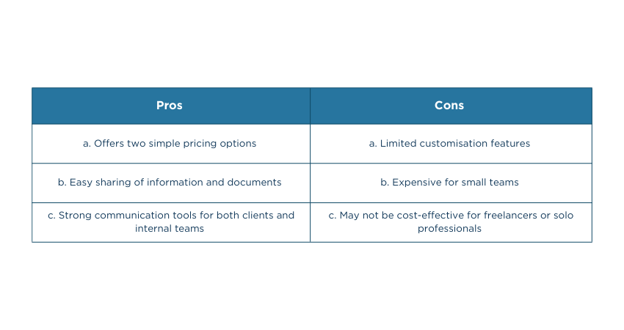
Here are some pros and cons of Basecamp:
Advantages of Basecamp:
a) Simple and User-Friendly Interface:
Easy to navigate and suitable for teams of all sizes.
b) Strong Client Collaboration:
Supports smooth client communication, feedback sharing, and project updates.
c) Cost-Effective for Large Teams:
Offers fixed pricing without additional per-user costs.
d) Minimal Complexity:
Focuses on essential Project Management features for easier team adoption.
e) Automated Team Check-ins:
Helps teams stay updated without excessive meetings or micromanagement.
Disadvantages of Basecamp:
a) Limited Customization:
Provides fewer workflow and dashboard customization options.
b) Fewer Integration Capabilities:
Supports fewer third-party integrations compared to some competitors.
c) Basic Automation Features:
Offers limited workflow automation and process optimization tools.
Less Suitable for Complex Projects:
May not fully support advanced project structures and detailed tracking requirements.
Advantages and Disadvantages of Monday
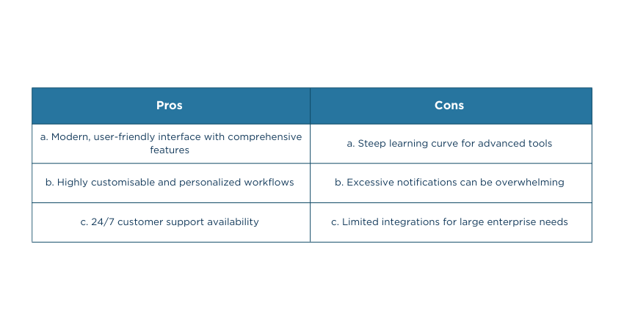
Understanding the pros and cons of monday.com can help you make the right choice for your business. Here are some:
Advantages of monday.com
a) Highly Customizable Workflows:
Allows teams to tailor workflows based on project and business needs.
b) Strong Integration Support:
Connects easily with various third-party business and productivity tools.
c) Workflow Automation:
Reduces repetitive manual tasks through automation capabilities.
d) Interactive Dashboards:
Provides visual project insights and real-time performance tracking.
e) Effective Time Tracking:
Helps teams monitor task duration and manage workloads efficiently.
Disadvantages of monday.com
a) Steeper Learning Curve:
Extensive customization options may take time for new users to understand.
b) Can Feel Complex for Small Teams:
Smaller teams may find some features unnecessary or overwhelming.
c) Higher Pricing Compared to Some Alternatives:
Advanced features and scaling options can increase overall costs.
Conclusion
At the end of the day, the Basecamp vs Monday choice isn’t about which tool is better, it’s about which one works better for you. Think about your team’s style, project needs, and how you like to get things done. The right platform can save hours, reduce stress, and keep everyone in sync. So, take your pick wisely.
Understand the importance of Project Management tools with our
Trello Training
. Join now for the best results!


 Back
Back

 Topics

 Courses


 10 Aug 2026
 Veronica Davis