Agile works smoothly when a single team is involved. But as more teams join, coordination can quickly become complex. Communication gaps appear, dependencies clash, and small delays can ripple into larger issues. This is the challenge many growing organizations face, and it is exactly where Scrum of Scrums becomes essential.
In this blog, we explain what Scrum of Scrums is and why it is used in large Agile projects. You will also explore its benefits, key goals, who is involved, and the best practices that help teams stay aligned and deliver together. Let’'s get started!
What is Scrum of Scrums?
Scrum of Scrums refers to a scaled Agile technique for connecting multiple teams that need to work collaboratively to deliver complex solutions. It helps teams deliver complex products through transparency, inspection, and adaptation at scale. It’s especially successful when every high-performing Scrum team member works towards a common goal, has trust and respect, and is completely aligned.

Scrum of Scrums Diagram
A Scrum of Scrums diagram shows how multiple Scrum teams stay connected through their representatives. Each team shares updates with a central coordination group, helping everyone stay aligned on progress, dependencies, and risks. This structure supports smoother communication across teams and ensures that cross-team issues are identified and resolved early.

Benefits of Scrum of Scrums
Scrum of Scrums has numerous benefits, including information sharing, collaboration, problem-solving and more. Some more benefits of Scrum of Scrums include the following:
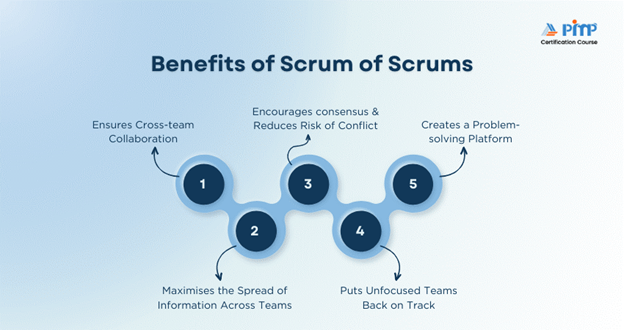
1) It ensures cross-team collaboration.
2) It maximizes the spread of information across Scrum teams through their representatives.
3) It encourages consensus, which in turn reduces the risk of conflict due to a lack of information.
4) It puts unfocused teams back on track.
5) It creates a problem-solving platform, and issues that Agile teams can’t fix can be resolved by gaining insight from other participants.
What are the Goals of Scrum of Scrums?
The goals of a Scrum of Scrum include:
1) Coordinating output from all the involved teams
2) Integrating multiple team’s productions into a single entity
3) Eliminating any bottlenecks
4) Supporting the Agile teams to enhance team productivity
5) Keeping teams aligned and in the know with each other
6) Deal with dependencies among multiple teams

With these goals in mind, each team representative must answer these questions:
1) Since the last meeting, what has your team accomplished?
2) Did any problems arise that created a roadblock?
3) What tasks does your team plan to achieve before the next meeting?
4) Do you anticipate any output from your team’s future sprints interfering with the work of other teams? If so, what are those outputs?
5) Have you experienced any obstacles stemming from other teams?
Learn how to integrate your Software Development expertise into Scrum environments with our
Scrum Developer Certification
now!
What is the Scrum of Scrums Meeting?
A Scrum of Scrums (SoS) meeting is a time-boxed coordination meeting used in large Agile environments where multiple Scrum teams work on the same product or related projects. It helps scale Scrum by enabling collaboration across teams without disrupting their individual workflows.
In this meeting, one representative from each Scrum team joins to share high-level updates rather than detailed task discussions. The focus is on progress, dependencies, risks, and blockers that affect more than one team. This allows teams to stay aligned, resolve cross-team issues early, and keep large, complex projects moving forward smoothly.
How to Conduct a Productive Scrum of Scrums Meeting?
A Scrum of Scrums meeting should be structured and time-boxed to support coordination across teams. Its focus is on alignment, shared dependencies, and resolving cross-team blockers. Here are the key practices for a productive meeting:
1) Send the Right Representatives:
Each Scrum team should appoint one or two people who understand the work and can speak and decide for the team.
2) Define What to Share:
Teams should come prepared to discuss progress, blockers, dependencies, and risks that affect other teams.
3) Fix Time and Frequency:
Schedule the meeting in advance, usually once or twice a week, and keep it time-boxed.
4) Focus on Cross-team Issues:
Discuss only topics that impact multiple teams, not detailed task updates or status reports.
5) Encourage Open Communication:
Create a safe environment where teams can raise concerns and share challenges honestly.
6) Solve Problems Collaboratively:
Use the meeting to remove blockers and agree on actions, taking deep discussions offline if needed.
7) Share Outcomes with Teams:
Representatives must relay decisions and updates back to their Scrum teams to maintain alignment.
Struggling to manage the product backlog as a Product Owner? Our comprehensive
Scrum Product Owner Certification
helps streamline the process – Sign up now!
Who is Involved in Scrum of Scrums?
These are the points to consider regarding the individuals involved in a Scrum of Scrum meeting:
1) A Scrum of Scrum team must feature between five and ten participants, and the representatives should be the Scrum Masters of each team.
2) If each team sends only their Scrum Master, there's the risk of bringing a limited perspective to the Scrum of Scrums.
3) For example, it’s rare for a tech person to be the Scrum Master, and it’s exactly that kind of input that larger meetings may require. The possible need for technical input suggests having two representatives from each team, maybe the Scrum Master and the tech person or perhaps a member of the development team.
4) Optionally, the Scrum of Scrums can also include the Product Owner. This person’s perspective can potentially come in handy. But the meeting shouldn’t be a forum for Product Owners to air grievances and attempt to make development decisions outside their wheelhouse.
5) While most meetings function perfectly well as a self-leading body, a larger group meeting may need someone to step into the Scrum Master role.
6) The bottom line is that any team responsible for a deliverable as part of the release plan should have a representative attending the Scrum of Scrums.

Scrum of Scrums Best Practices
Now that the benefits and hierarchy of a Scrum of Scrums meeting have been covered let's explore the best practices that you must implement to improve it:
a) Everyone must understand the purpose of this meeting and come prepared.
b) There must be a time-box and an established frequency for every meeting.
c) When individual Agile teams select representatives, they must choose ambassadors who can effectively represent their team and communicate progress.
d) Representatives must relay information pertaining to a Scrum of Scrums meeting back to their Agile teams.
Conclusion
Scrum of Scrums brings clarity to complex Agile programs by connecting teams without slowing them down. With the right structure, it turns updates into action, risks into solutions, and silos into collaboration. When teams communicate clearly and decide fast, large projects move forward with confidence, alignment, and real momentum across growing organizations worldwide.
Boost your Agile expertise with our
Scrum Certification
and lead high-performing teams with confidence.


 Back
Back

 Topics

 Courses


 10 Aug 2026

 David Walter