Ever used a mobile app and thought, “This is exactly what I needed”? That experience is no accident at all. It is guided by a Scrum Product Owner who understands user needs, business goals, and what the team can deliver. They turn real problems into valuable features that make products people love to use.
In this blog, you will explore what a Scrum Product Owner does and the skills that make them effective. You will also learn how their role differs from that of a Scrum Master. Get ready to discover the driving force behind successful products!
What is a Scrum Product Owner?
In Scrum, the Product Owner represents key stakeholders and understands users, market needs, competitors, and trends. They ensure the development team focuses on features that deliver the most value to the business and customers.
Their main job is to manage and prioritize the product backlog. They guide sprint planning, clarify goals, and answer questions so the team knows what to build and why. The team then decides how much work they can complete for each sprint, keeping the process efficient and value-driven.
Scrum Product Owner Roles
Along with the Scrum Master and development team, a Product Owner plays an important role in the Scrum team. However, the Product Owner must ensure that the responsibilities of the other two roles don't overlap. The role of the Scrum Product Owner involves the following:
1) Domain Knowledge and Experience
Domain knowledge is vital for the role of the Product Owner. Product and industry knowledge is one of the biggest reasons for hiring Product Owners. Ideally, the Product Owner must understand the customer, the industry, and how they use it.
2) Leadership and Communication Skills
One significant responsibility of the role is interacting with many stakeholders, so it's imperative to convince team members to achieve the required goal.
3) Maximize Value
The product must be released quickly. Hence, it is essential to prioritize requirements and what's of utmost importance for delivery. The Scrum Product Owner must ensure maximum product value aligned with customer expectations and the product vision.
4) Effective Interpretation of Customer Requirements
The Scrum Product Owner must interpret customer requirements and define them with product functionality. These requirements must be properly translated and communicated in the correct technical language so the development team can easily interpret them.
Master the craft of overseeing the product lifecycle in Scrum environments in our detailed
Scrum Product Owner Certification Course
– Register now!
Scrum Product Owner's Responsibilities
A Scrum Product Owner must realize maximum value for the organization, which means closely collaborating with the development team and ensuring all product requirements are well-defined and executed on time.
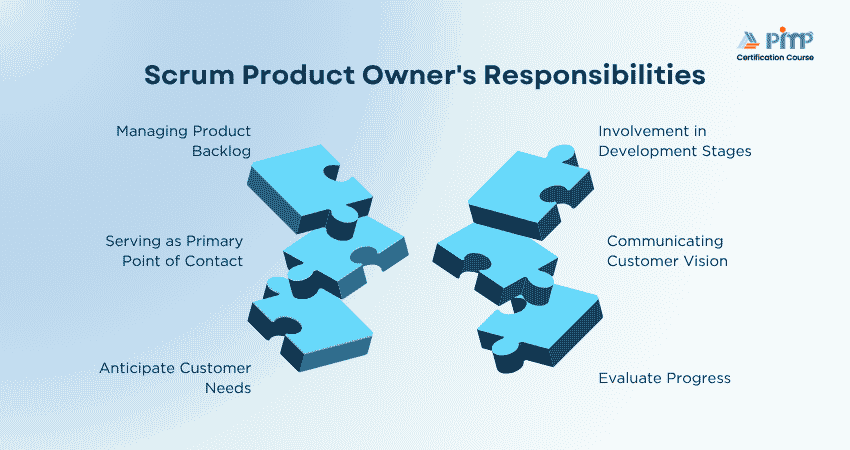
1) Product Backlog
A Scrum Product Owner's main responsibility is managing a product backlog. They must define the product based on customer requirements. The Product Owner must perform the following tasks:
a) Order the product backlog correctly so that the essential tasks are given topmost priority.
b) Prioritize work items and product backlog in alignment with customer needs.
c) Evaluate the development team's work and provide constant feedback.
d) Ensure the product backlog is communicated to every team member.
2) Development Stages
A Scrum Product Owner must be proactively involved in the product development process. As the customer objectives change, they must be monitored and conveyed to the development team. It is also good for a Product Owner to participate in sprint review meetings while identifying improvement areas.
3) Acting as a Primary Point of Contact
The role of a Scrum Product Owner is unique because they're the primary point of contact for all the stakeholders. They must ensure appropriate buy-in from management, customers, and development teams. This is essential for the smooth execution of product delivery.
4) Communicating Customer Vision
A Scrum Product Owner's perspective on customer goals and objectives must be adequately defined and communicated to the relevant stakeholders. This includes the customer, Scrum Master, development team, project team, and the corresponding Business Managers.
5) Adept and Anticipate Customer Needs
A Scrum Product Owner must have adequate industry and market experience to anticipate customer needs. They must also understand customer needs from a journey lifecycle perspective, which will help them better understand long-term customer goals and anticipate changes.
6) Evaluation of Progress
A Scrum Product Owner must have the ability to monitor every phase of the product development cycle. At each iteration, they must participate in the product development review and suggest changes on behalf of the customer. Based on the Product Owner's feedback, the development team can make necessary modifications to the product features.
Leverage the union of Software Development and Scrum environments for project excellence! Sign up for our
Scrum Developer Certification Training
now!
Skills for Scrum Product Owner
A Scrum Product Owner needs strong business understanding, analytical skills, and excellent communication to guide the product in the right direction while ensuring maximum value is delivered by the team.
1) Business Analysis
A Scrum Product Owner must understand business goals, customer needs, and market changes. This helps them identify valuable features, prioritize the product backlog, and make sure each requirement adds value to the organization and users.
2) Critical Thinking
Critical thinking allows a Product Owner to review ideas carefully, assess risks, and make smart decisions. It helps them analyze information effectively and ensure that product choices are based on real insights.
3) Decision-making
Scrum Product Owners make frequent decisions regarding features and priorities. Strong decision-making keeps the development team focused and on track, avoiding unnecessary delays and confusion.
4) Problem-solving
A Scrum Product Owner must be able to quickly recognize issues and find solutions. This skill helps them remove barriers, handle changing requirements, and support smooth product delivery throughout the project.
5) Information Technology
A basic understanding of software development and digital tools helps the Product Owner communicate well with developers. It allows them to assess feasibility, suggest improvements, and improve the overall product quality.
6) Communication and Collaboration
Scrum Product Owners act as the connection between stakeholders and the Scrum team. Clear communication ensures shared understanding, while good collaboration builds trust and enables faster feedback and better results.
Scrum Product Owner Stances
A Scrum Product Owner dons many hats including that of a visionary leader, customer champion, and value maximizer, ensuring the team builds what truly matters for users and the business.
1) Visionary:
A Scrum Product Owner supports the product vision that helps to meet the organization's vision.
2) Collaborator:
A Scrum Product Owner collaborates closely with cross-functional teams such as designers, marketers, developers, and quality assurance to make sure the product meets customer needs.
3) Customer Representative:
A Product Owner is the primary advocate for customers, ensuring that their needs and expectations are validated in the product development process.
4) Decision Maker:
A Scrum Product Owner makes strategic decisions regarding the product roadmap, feature prioritization, and resource allocation based on input from the development team and stakeholders.
5) Experimenter:
The Product Owner encourages experimentation within the development team, promoting an environment where new ideas can be tested and refined.
6) Influencer:
Scrum Product Owners use their strong relationships with stakeholders and the development team to influence others to support the product vision and strategy.
Differences Between the Scrum Master and Scrum Product Owner
The Scrum Product Owner focuses on what the team should build and why. Meanwhile, the Scrum Master ensures that the team works efficiently and is aligned with Scrum principles.
Here are the key differences:

Conclusion
A Scrum Product Owner guides product vision, sets priorities, and ensures the team delivers meaningful value. Their skills in strategy, collaboration, and customer understanding help create products that support business growth. As Agile adoption increases, this role offers strong career opportunities for those who want to shape successful products.
Boost your career growth and build strong Agile product delivery skills. Join our
Scrum Certification
now!


 Back
Back

 Topics

 Courses


 10 Aug 2026

 David Walter