What does “done” really mean in your project? Is it coded, tested, approved, or deployed? If your team cannot answer this clearly, you may already have a quality gap. Very often, work is marked complete based on assumptions rather than agreed-upon standards, which leads to rework, delays, and unmet expectations. This is where the Definition of Done plays a crucial role.
The term might look straightforward, but it holds a deeper significance in ensuring task completion. It defines exactly when a task or product increment is considered complete. In this blog, we’ll explore what is the Definition of Done, why it matters in Agile and project environments, and practical examples that show how it works in real-world scenarios. Let's dive in!
What is a Definition of Done?
Definition of Done (DoD) is a shared set of criteria in Agile that defines when a task, user story, or product increment is considered complete and ready for use or release. It ensures the work meets agreed quality standards such as coding, testing, documentation, and review before delivery. The DoD is typically defined by the Agile team, often with input from the Product Owner and organisational quality standards.
For example, consider a tractor manufacturing plant. The operational head may set specific quality checks before a tractor is marked as complete, such as ensuring it runs without unusual noise, is fully painted, has all nuts and bolts tightened, and the tyres are properly aligned. The tractor is only considered finished once all these conditions are met.

Why is the Definition of Done Important for Product Managers?
Definition of Done serves as a foundational stone for the productivity and efficiency of the Product Managers. Here are the reasons why it is important for these key professionals:
1) Enhances Product Quality and Consistency: The Definition of Done provides clear criteria for professionals to measure task completion. This approach ensures that all the crucial deliverables meet high standards of quality and consistency.
2) Aligns Team Expectations: It helps align the team’s understanding of when a feature is ready for release, minimizing misunderstandings and ensuring everyone is on the same page.
3) Reduces Rework and Time-to-market: By establishing a robust DoD, Product Managers can ensure that releases meet user needs. This further reduces the need for rework and speeds up time-to-market.
4) Supports Transparency in Workflows: Definition of Done also makes the task easier for the team members to track progress and prioritize tasks. It further provides a clear view of the completed and remaining tasks.
5) Empowers Better Scope Management: It helps Product Managers manage scope effectively, allocate resources efficiently, and maintain alignment with project goals.
6) Improves Stakeholder Communication: Definition of Done provides a concrete standard for deliverables, while serving as a shared language between technical teams and stakeholders. This helps set accurate expectations and maintain the highest levels of trust.
7) Manages Technical Debt: Emphasizes thorough testing, documentation, and code review before marking tasks as done, preventing the accumulation of technical debt that could impact future releases.
8) Drives Continuous Improvement: By regularly reviewing and updating the DoD based on team feedback, Product Managers can ensure it evolves to accommodate new challenges, technologies, or quality standards.
When is the Definition of Done Created?
The Definition of Done is typically created at the beginning of a project or during the early stages of an Agile framework, such as during project initiation or the first sprint planning session. Establishing it early ensures that all team members share a common understanding of what “complete” means before any significant work begins.
However, the Definition of Done is not static. It can be reviewed and refined as the project evolves, especially if standards, tools, or compliance requirements change. This ensures it remains relevant and continues to support consistent, high-quality delivery.
How to Create a Definition of Done?
For the Definition of Done to be accurate, it's important to establish it early in the project. This helps set consistent expectations and defines when work can be considered complete. Here are the steps to create a Definition of Done below:
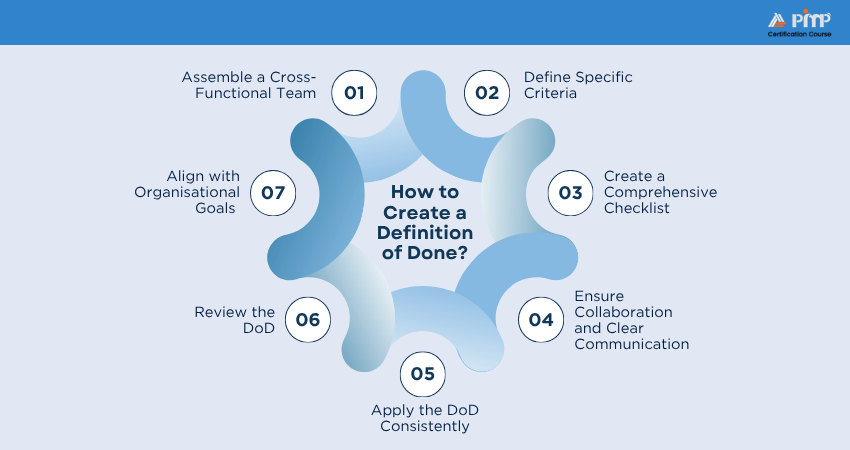
1) Assemble a Cross-functional Team
Gather a diverse group of Software Developers, Software Testers, and Product Managers. This team will collaboratively define the criteria for when a task or feature is considered complete. Involving different perspectives ensures that the DoD is comprehensive and addresses all necessary aspects of the development process.
2) Define Specific Criteria
Establish clear and detailed technical checks such as code reviews, various levels of testing (unit, integration, and user acceptance), documentation updates, and stakeholder approvals. These criteria ensure that every deliverable meets the required quality and functionality standards before it is considered done.
3) Create a Simple yet Comprehensive Checklist
Develop a checklist that is simple and comprehensive yet detailed enough to cover all essential quality checks of the final product. This checklist should be used consistently to ensure that all deliverables meet the same high standards as the previous products. This helps in avoiding any kind of oversight or missed steps.
4) Ensure Collaboration and Clear Communication
Create a working environment where all the team members can openly discuss and agree on the DoD. Clear communication is important to ensure that everyone understands the criteria and their importance, which further reduces the ambiguities and the need for revisions. In addition, regular meetings and updates can help maintain this clarity.
5) Apply the DoD Consistently
Implement the established DoD across all projects to maintain a high level of quality and consistency. Consistent application helps achieve predictable outcomes and ensures that all team members are aligned in understanding what constitutes a completed task or feature.
6) Review the DoD
Review the DoD periodically to incorporate new insights, feedback, or process improvements. This ensures that the DoD remains relevant, practical, and adaptable to technological changes, team dynamics, or project requirements.
7) Align with Organizational Goals
Ensure that the DoD aligns with the organization's broader goals and compliance requirements. This alignment helps the stakeholders to achieve strategic objectives and make sure that all deliverables strongly adhere to the organization's overall mission and vision.
Gain hands‑on experience with real‑world Scrum workflows with our Scrum Developer Certification - Sign up today!
Definition of Done Examples
The Definition of Done can vary depending on the project type, industry, and team structure. However, its purpose remains the same, to clearly define when work is truly complete. Below are practical examples from different project environments to illustrate how a Definition of Done might look:
1) Software Development Project
1) Code is written according to agreed coding standards
2) Code is reviewed and approved by a peer
3) All unit tests and integration tests pass successfully
4) User acceptance criteria are fully met
5) No critical or high-priority bugs remain open
6) Performance requirements are validated
7) Security checks or vulnerability scans are completed
8) Documentation and release notes are updated
9) The feature is deployed to the required environment
10) Product Owner approval is received
2) Marketing Campaign Project
1) Campaign objectives are clearly defined and approved
2) Campaign content is created and proofread
3) Visual and design assets are reviewed and approved
4) Brand guidelines are followed consistently
5) Legal or regulatory checks are completed
6) Budget allocation is confirmed
7) Target audience segmentation is verified
8) Campaign is scheduled or published across platforms
9) Tracking links and analytics tools are properly configured
10) Performance tracking metrics are set up and tested
3) Construction Project Task
1) Task is completed according to approved drawings and project scope
2) Measurements and dimensions are verified against specifications
3) Materials installed match the approved bill of quantities
4) Work meets structural, safety, and building code requirements
5) On-site quality inspection is completed and recorded
6) Snag list items related to the task are cleared
7) Health and safety checks are conducted and documented
8) Relevant compliance certificates are obtained (if applicable)
9) The site is cleaned and prepared for the next phase of work
10) The Project Manager or Site Engineer formally signs off on the task
Definition of Done in the Organization
The Definition of Done does not operate only at the task or sprint level. In reality, it plays an important role across the entire organization. As projects scale and multiple teams work together, a shared understanding of completion must extend beyond individual tasks. Here is how it works at the organizational level:
1) Team Level
At the team level, the Definition of Done focuses on completing specific tasks, user stories, or deliverables. It ensures that daily work meets the agreed requirements before being marked complete.
For a Software Development team, the DoD may include successful unit and integration testing, peer code reviews, updated documentation, resolved critical defects, and Product Owner approval.
2) Program Level
At the program level, the Definition of Done expands beyond individual tasks to ensure that related projects collectively deliver intended outcomes. It focuses on integration, cross-team dependencies, and alignment with program objectives.
For example, in a large software product release involving backend, frontend, and DevOps teams, the program level DoD may include successful system-wide integration testing, validated end-to-end user journeys, resolved cross-team dependencies, performance benchmarking, security validation, and stakeholder approval for release readiness.
3) Portfolio Level
At the portfolio level, the Definition of Done aligns with strategic priorities and organizational value. Completion is not only about deliverables but about achieving measurable business outcomes. This may include meeting financial targets, realising expected benefits, and aligning with a long-term strategy.
For a Software Development portfolio, the DoD may include achieving targeted revenue growth from the product, meeting user adoption benchmarks, and maintaining Service-level Agreements (SLAs).
Lead Agile teams with Scrum Product Ownership - Join our Scrum Product Owner Certification today!
Common Challenges of Definition of Done
Although the Definition of Done improves clarity and quality, teams often face challenges in applying it effectively. Common challenges include the following:
1) Lack of Alignment: Team members may interpret completion criteria differently
2) Vague Standards: Unclear or non-measurable criteria may create confusion
3) Overcomplication: Too many rules can slow progress and reduce project Agility
4) Outdated Criteria: Failure to review and update the DoD makes it less relevant
5) Cross-team Gaps: Different teams may follow inconsistent standards
6) Checkbox Mindset: Treating the DoD as a formality weakens its impact
Definition of Done vs Definition of Ready
The Definition of Done (DoD) and the Definition of Ready (DoR) are both quality control mechanisms in Agile and project management, but they serve different purposes. The Definition of Ready focuses on when work is prepared to begin, while the Definition of Done determines when that work is truly complete.
The Definition of Ready ensures that a task or user story is clear, well-defined, and actionable before development starts. It helps teams avoid confusion and rework by confirming that requirements are understood in advance. On the other hand, DoD ensures that completed work meets previously stated requirements before it is delivered or released. Here is a detailed difference between Definition of Done and Definition of Ready:
Conclusion
We hope you now understand the Definition of Done and its role in improving quality, clarity, and efficiency in Agile projects. The DoD serves as a cornerstone for setting clear standards for completion, ensuring teams deliver consistent and high-quality products. Furthermore, adopting a robust DoD can minimize rework, improve stakeholder communication, and streamline development.
Unlock new leadership opportunities in Agile environments with Scrum Certification – Join now!


 Back
Back

 Topics

 Courses


 10 Aug 2026

 David Walter