What if you could manage any project regardless of size, industry, or complexity with the same core method? Think about it: less stress and last-minute problems, more planning ahead with fewer delays, more successful results.
That’s the promise behind the Project Management Body of Knowledge. It is a trusted framework that helps professionals lead with purpose and plan carefully while adjusting to the changes without slowing down. In this blog, we’ll explore the core of PMBOK, its principles, five process groups, and the real-life advantages of using it. Let's dive in!
Table of Contents
1) What is Project Management Body of Knowledge (PMBOK)?
2) PMBOK Principles of Project Management
3) Five Process Groups of PMBOK
4) The 10 Knowledge Areas of PMBOK
5) What Project Managers can do with PMBOK?
6) PMBOK Project Management Tools and Techniques
7) Benefits of PMBOK
8) Drawbacks of PMBOK
9) Conclusion
What is Project Management Body of Knowledge (PMBOK)?
Project Management Body of Knowledge represents a full set of standards, processes, guidelines, and best practices accepted within the Project Management. Developed and maintained by the Project Management Institute (PMI), it provides a globally recognized framework that helps Project Managers deliver consistent, high-quality results across industries.
PMBOK Principles of Project Management
In its latest editions, PMBOK has evolved to incorporate a more principle-based approach alongside the traditional process-oriented structure. These principles provide general guidance that can be used in any industry or type of project. Key principles include:
a) Stewardship: Refers to acting with integrity, care, and responsibility while considering social, environmental, and financial impacts.
b) Team: Each team needs to encourage collaboration, and strong teams achieve more than individuals working alone.
c) Stakeholders: As a business or for a project, you have to engage proactively with stakeholders to ensure alignment and satisfaction.
d) Value: Focus on delivering meaningful value, not just outputs, throughout the project lifecycle.
e) Systems Thinking: You can view the project holistically and understand how internal and external systems would interact.
f) Leadership: Promote adaptable, inspiring leadership at all levels, not just from managers.
g) Tailoring: In every project, you can adapt processes to meet the specific needs of the project for maximum efficiency.
h) Quality: Define and meet stakeholder expectations through continuous focus on quality.
i) Complexity: Recognize and manage complexity that is caused by systems, people, or uncertainty.
j) Risk: Identify and manage threats and opportunities to improve outcomes.
k) Adaptability and Resilience: Stay flexible and recover quickly from challenges or changes.
l) Change Management: Prepare people for unexpected changes and manage transitions by involving Change Management in the project lifecycle.
Five Process Groups of PMBOK
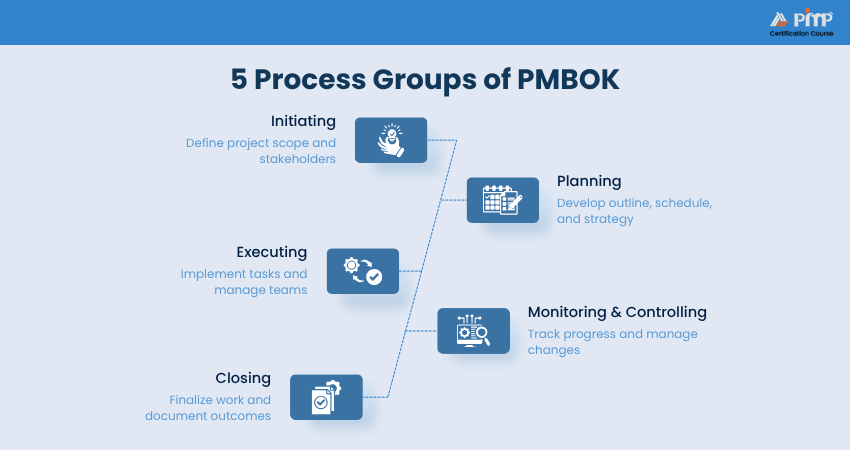
PMBOK divides the project activities into five main stages, known as process groups. These stages are not sequential but often overlap and work together during the project lifecycle. Here are those five process groups:
1)Initiating
This is the first step of starting the project in the right way. You define what the project is, what it aims to achieve, and who is involved. Outputs from this phase include:
1) Project charter (a document that starts the project)
2) List of stakeholders
3) Key objectives of your project
The goal is to establish a strong foundation and shared understanding before any work starts.
2) Planning
Planning is about getting everything in order before work starts. It includes deciding what needs to be done, when, how much it will cost, and how to deal with risks. Key plans include:
1) Full project plan with its scope
2) Timelines, resources and budgets
3) Communication and risk plans
This stage in the process groups helps make sure there are no surprises once the project begins.
3) Executing
This is the phase where the project plan comes to life. The team executes tasks, collaborates across functions, and works toward delivering results. Key activities include:
1) Coordinating with vendors and partners
2) Supporting team performance and collaboration
3) Ensuring deliverables meet quality standards
The focus is on execution, teamwork, and steady progress toward project goals.
4) Monitoring & Controlling
This happens throughout the project and runs in parallel with execution. It involves tracking progress, measuring performance, and managing changes to keep the project on course.
1) Validating deliverables
2) Applying change control for scope or schedule updates
3) Monitoring risks using a risk register
It also includes risk monitoring and taking corrective actions to handle issues before they escalate.
5) Closing
The final process group focuses on completing all project work, leading the project to a formal end. It includes handing over deliverables, releasing resources, closing contracts, closing contracts, and releasing resources. Outputs:
1) Final project report
2) Lessons learned
3) Administrative closure
It also conducts a post-project review to capture lessons learned and maintain consistency within the project.
Stand out in the world of Project Management with our Certified Associate in Project Management (CAPM) ® Training – Register today!
The 10 Knowledge Areas of PMBOK
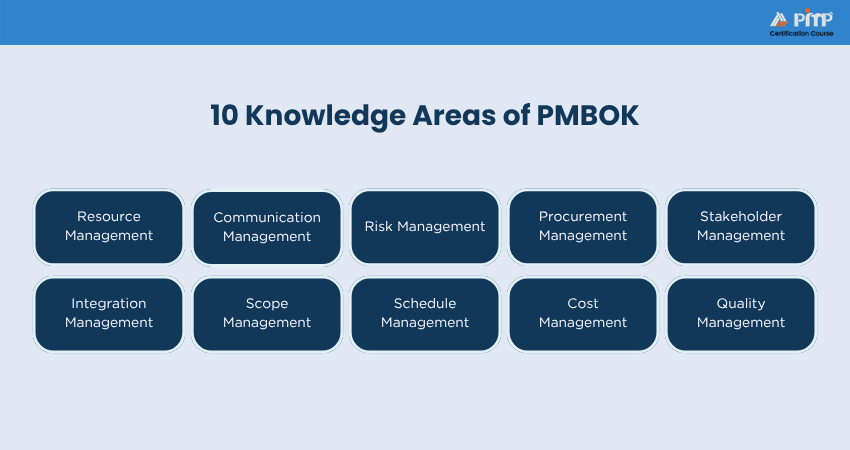
PMBOK outlines 10 knowledge areas, each representing an important aspect of Project Management. These are applied across the five process groups. Here are those knowledge areas:
1) Resource Management
Resource Management is about acquiring, developing, and overseeing the people, equipment, and materials needed to complete a project successfully. It includes:
1) Resource allocation and capacity planning to balance workload
2) Skills assessment to match team members with the right tasks
3) Tools to clarify roles and responsibilities
4) Performance assessments to track team effectiveness
5) Managing virtual teams and resolving conflicts
2) Communication Management
Good communication keeps projects running smoothly. So, Communication Management ensures the right information reaches the right people when required. It involves:
1) Planning communication and selecting appropriate channels for it
2) Using sender-receiver models and feedback loops for clarity
3) Providing regular status reports and updates to stakeholders
4) Applying tools like the Stakeholder Engagement matrix
5) Establishing escalation paths for issues
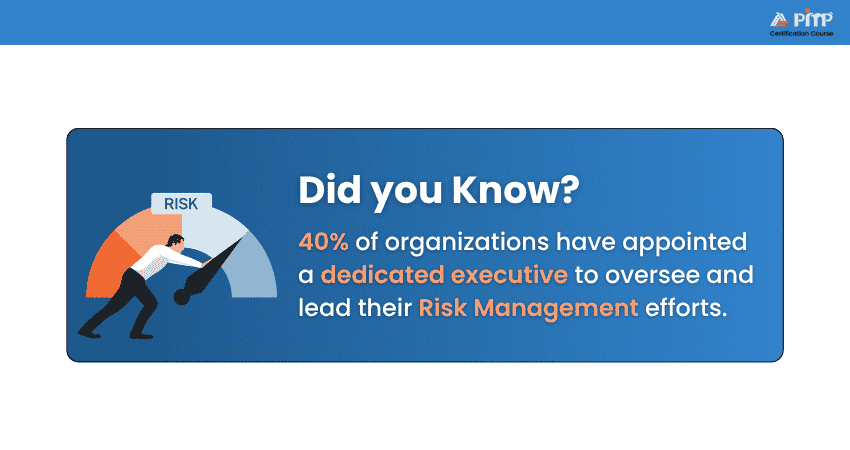
3) Risk Management
Risk Management keeps you prepared for both good and bad situations. It involves identifying, analyzing, and responding to risks before they impact project success. Key strategies are:
1) Maintaining a risk register
2) Performing qualitative and quantitative risk analysis
3) Planning risk responses like avoid, mitigate, transfer, or accept
4) Developing backup plans
5) Conducting periodic risk reviews throughout the project
4) Procurement Management
Procurement Management covers how you acquire goods or services from external vendors. It ensures that what has been bought adds value to the project. It includes:
1) Make-or-buy analysis to decide whether to outsource
2) Preparing and managing Request for Proposals (RFPs)
3) Choosing the right contract types, like fixed-price or timely materials
4) Evaluating vendor proposals and selecting suppliers
5) Negotiating contracts, setting clear terms, and managing delivery
5) Stakeholder Management
Stakeholder Management ensures that everyone who has an interest in the project is engaged. It builds strong relationships and increases the chances of project success. This involves:
1) Identifying stakeholders early and analyzing their influence
2) Using tools like the power-interest grid and influence-impact matrix
3) Managing expectations through clear communication
4) Gathering continuous feedback to adjust engagement plans
5) Applying Change Management techniques and conflict resolution
6) Integration Management
Integration Management brings together all aspects of a project to work in harmony toward a shared goal. It helps various elements or teams collaborate and coordinate. Key activities are:
1) Developing the project charter and Project Management plan
2) Managing project execution and change control
3) Consolidating outcomes and ensuring all components align
4) Overseeing the overall progress to deliver a unified outcome
Take your leadership to the next level with our Program Management Professional (PgMP)® Certification – Join soon!
7) Scope Management
Scope Management focuses on ensuring the project includes only the work required. This prevents scope creeps, which is when extra tasks sneak in and disturb the project. It involves:
1) Defining project scope and deliverables clearly
2) Creating a Work Breakdown Structure (WBS)
3) Verifying that completed work meets original requirements
4) Controlling changes to the scope as the project progresses
8) Schedule Management
Schedule Management is about creating, maintaining, and updating a realistic project timeline. It checks if tasks are completed on time and resources are used effectively. It consists of:
1) Defining project activities and task dependencies
2) Creating a project schedule using tools like Gantt charts
3) Adjusting deadlines as needed while maintaining accountability
4) Monitoring progress and addressing any delays quickly
9) Cost Management
Cost Management focuses on the financial side of the project. It provides planning, budgeting, and controlling costs while the project stays within its approved budget. Key activities include:
1) Estimating costs for resources, labor, and materials
2) Creating a cost baseline
3) Tracking and controlling spending
4) Adjusting budgets if needed while maintaining financial discipline
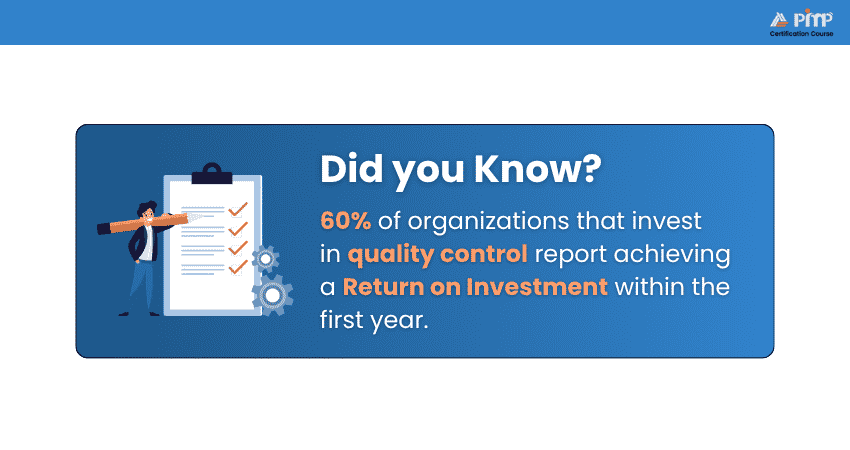
10) Quality Management
Quality Management checks if the project’s deliverables meet defined standards and satisfy customer expectations. It includes quality planning, assurance, and control. It focuses on:
1) Setting quality metrics and acceptance criteria
2) Applying process improvement methodologies to reduce defects
3) Promoting continuous improvement to refine processes over time
4) Monitoring the cost of quality (CoQ) to balance prevention and failure costs
What Project Managers Can Do With PMBOK?
The PMBOK is a vital resource for Project Managers who want to improve their skills, deliver better results, and manage projects with greater confidence. Whether a project is big or small, PMBOK helps them to keep their team organized, focused, and on the same page.
It also enables Project Managers to bring consistency to how their teams work. It helps them plan better, communicate clearly, and manage risks early before they become major problems. It helps ensure that project outcomes meet both the defined goals and the expectations of stakeholders.
Lead projects confidently and deliver results with our PMP® Certification – Sign up anytime!
PMBOK Project Management Tools and Techniques
PMBOK includes a variety of tools and techniques to effective project execution. Common examples include:
1) Work Breakdown Structure (WBS):
A WBS divides the project into smaller, manageable tasks and deliverables in a hierarchical format. It helps the team understand what needs to be done and their responsibilities clearly.
2) Gantt Charts:
These are bar charts that show the project timeline, task dependencies, and progress at a glance. Gantt charts are widely used for scheduling and tracking task completion.
3) Project Network Diagrams:
These diagrams visually show the sequence of project tasks and their dependencies. They help estimate project duration and identify logical task flow.
4) Critical Path Method (CPM):
CPM identifies the longest path of dependent tasks in a project. It helps Project Managers find critical tasks that cannot be delayed without affecting the project’s end date.
5) Program Evaluation and Review Technique (PERT):
PERT is used to estimate how long tasks will take when there is uncertainty. It uses three-time estimates such as optimistic, pessimistic and accurate duration.
6) Earned Value Management (EVM):
EVM measures project performance by comparing the amount of work planned versus completed and the actual cost versus the planned cost.
7) Cost Estimating Techniques:
These include tools like analogous estimating (based on past projects) and parametric estimating (using formulas or data) to predict project costs.
8) Schedule Compression Techniques:
These are used when projects are behind schedule. Techniques like crashing (adding resources) and fast-tracking (doing tasks in parallel) help reduce the timeline without changing the scope.
9) Rolling Wave Planning:
This is a planning method where near-term tasks are planned in detail, while longer-term tasks are planned at a higher level and refined later. It supports flexibility and continuous planning.
10) Cost-benefit Analysis:
This technique helps decide if a project or action is worth it. It compares expected costs against expected benefits to support smarter decision-making.
Benefits of PMBOK
Here are the benefits of using Project Management Body of Knowledge for your project:
1) Standardization: Ensures consistent project practices across teams and industries
2) Clear Communication: Improves stakeholder alignment through structured updates
3) Defined Process Phases: Offers step-by-step guidance from start to finish
4) Comprehensive Knowledge: Covers all key project areas, including risk, scope, and cost
5) Risk Mitigation: Promotes proactive risk identification and control
Drawbacks of PMBOK
Though PMBOK has its benefits, it has its challenges too. Let's check its drawbacks:
1) Too Rigid: Less flexible for agile or rapidly changing environments
2) Complexity: Can overwhelm small teams or simple projects
3) Heavy Documentation: May increase admin workload
4) Generic Guidance: Lacks industry-specific depth
5) Slow to Adapt: Less suited for fast-paced or evolving methodologies
Conclusion
The Project Management Body of Knowledge (PMBOK) remains one of the most trusted and widely used frameworks in Project Management. It equips you with the tools needed to plan, execute, and complete projects effectively across any industry. Through successful implementation, you can lead with greater confidence, align your team with clear goals, and deliver results that truly make an impact.
Ready to move from managing tasks to leading with strategy? Join our Project Management Institute (PMI)® Certification immediately!


 Back
Back

 Topics

 Courses


 10 Aug 2026
 Veronica Davis