Projects rarely succeed by chance; they succeed through control and careful planning. Project Controls supply the structure that helps Project Managers track progress, manage budgets, and keep the schedules on track. From identifying risks to monitoring performance, these practices ensure projects remain aligned with goals and stakeholder expectations.
In this blog, we'll explore What are Project Controls, why they matter, and how they help organizations deliver projects efficiently. So read on, learn to minimize uncertainty and achieve consistent project success across complex initiatives!
What are Project Controls?
Project Controls refer to the methods and tools used to monitor and manage a project’s performance. They act like a navigation system for a project, helping teams track progress, assess direction, and ensure everything stays on the planned path.
By combining data collection, analysis and reporting, Project Controls provide clear visibility into a project's overall health. This insight helps teams identify potential issues early, make informed decisions, and stay in alignment with stakeholders throughout the entire project lifecycle.
Why are Project Controls Important?
Project Controls provide visibility into costs and timelines which allows teams to respond efficiently to budget limitations and schedule changes. Project Managers typically begin by thoroughly understanding the project’s objectives. This understanding helps them identify the key areas that can be managed and optimized throughout the project lifecycle.
Risk Management is a critical component of Project Control. It enables teams to anticipate and address potential challenges before they escalate. Collecting relevant data is another essential step in implementing effective Project Control. This may involve reviewing historical project data or consulting subject matter experts to anticipate potential issues.
Objectives of Project Controls
Project Control plays a vital role throughout the entire project lifecycle, from initiation to completion. The primary objectives include:
1) Maintaining Schedule and Budget:
Project Controls help ensure that projects are completed within the planned timeline and allocated budget. This reduces the risk of delays and cost overruns.
2) Ensuring Quality Delivery:
They support the delivery of project outcomes that meet the expected quality standards and stakeholder expectations.
3) Detecting and Managing Risks:
Project Controls help identify potential risks early. This allows teams to address issues before they lead to delays, disruptions, or financial challenges.
4) Supporting Informed Decision-making:
By providing accurate and real-time data, Project Controls enable Project Managers to make well-informed and strategic decisions.
5) Strengthening Accountability:
They promote consistent reporting and transparency among project teams and stakeholders. This improves responsibility and coordination.
6) Maintaining Compliance:
Project Controls help ensure that projects adhere to relevant regulations, industry standards and organizational policies.
7) Facilitating Effective Change Management:
They provide a structured framework for managing minor adjustments as well as significant changes throughout the project lifecycle.
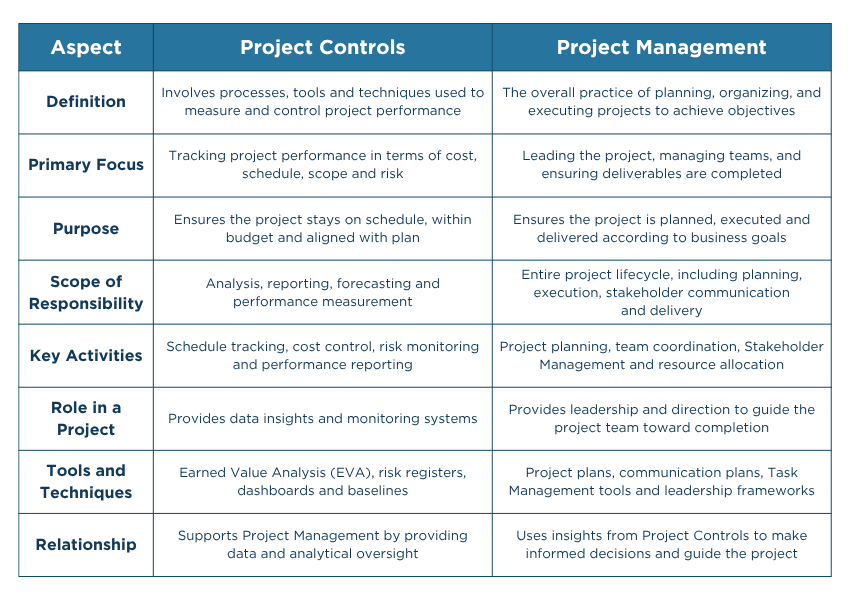
Project Controls vs Project Management
Here are the key differences between Project Controls and Project Management:
When to Use Project Controls?
Project Controls' real value becomes evident when applied to practical Project Management. Project Controls play a role at every stage of the project lifecycle. Let’s explore how they function across different phases of a project:
1) Project Planning
Project Controls are established during the early stages of a project when schedules are created, teams are formed, tasks are defined, stakeholders are identified and objectives are set. They are especially important when estimating project costs and timelines. Since time and cost are two of the most critical constraints in any project, thus implementing controls at this stage helps ensure more accurate planning and Risk Management.
2) Project Execution & Project Monitoring
During execution, Project Controls help keep the team focused and ensure the project stays on schedule and within budget. This requires continuous tracking of progress. Project Controls help Managers detect issues such as delays, resource imbalances or quality concerns. By analyzing data, Project Managers can quickly identify bottlenecks and take corrective action.
3) Project Closure
A project does not simply end when the deliverables are completed, and stakeholders are satisfied. The closure phase also involves administrative tasks, reassignment of teams, and the codirection of performance data via Project Controls. Reviewing this information helps identify what worked well and what could be improved. It provides valuable insights that can boost future projects.
Lead projects with ease by mastering the schedule that drives them. Sign up for our
PMI Scheduling Professional (PMI-SP)® Certification
now!
Types of Project Controls
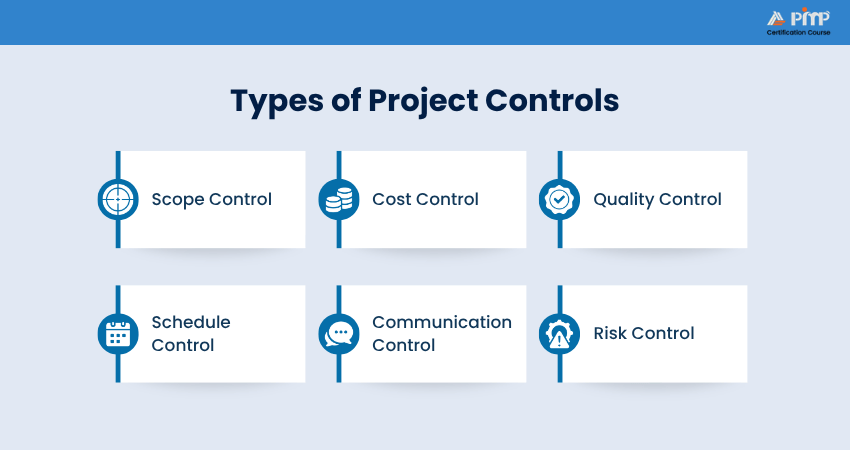
While there are several types of Project Control, these key areas stand out as essential for maintaining a project's integrity and ensuring its success:
1) Scope Control
Scope control is about managing any changes to the project's originally defined parameters. Managers must vigilantly monitor the project's boundaries to ensure the final deliverables align with the outcomes established during the planning phase.
2) Cost Control
Cost control focuses on managing a project's financial aspects. It involves tracking expenses, forecasting future costs, and adjusting to keep the project within budget. This might include negotiating with vendors, optimizing resource allocation or finding cost-effective alternatives to expensive solutions.
3) Quality Control
Quality control ensures that the project deliverables exceed the defined standards. This involves implementing quality assurance processes, conducting regular inspections and addressing any deviations from the set quality requirements.
4) Schedule Control
Equally important is schedule control, which calls for continuous oversight of the project timeline. Project Managers must track progress, identify potential delays and implement corrective actions to keep the project on track. Tools like Gantt Charts or Project Scheduling Software can be invaluable for visualizing the project schedule.
5) Communication Control
Lastly, communication control is vital to project success by fostering transparency and engagement among all stakeholders. This involves establishing clear communication channels, ensuring timely dissemination of information, and actively managing stakeholder expectations. Project Managers might use various techniques to keep stakeholders engaged, such as project dashboards or collaboration platforms.
6) Risk Control
Risk control is an ongoing process of managing potential threats to project success. Project Managers must proactively anticipate risks that could impact the project's scope, schedule, cost or quality. Risk control might involve developing contingency plans, implementing risk mitigation strategies or adjusting project plans to account for identified risks.
5 Key Steps to Implement Project Controls
Implementing Project Controls is a progressive process rather than an instant solution. The aim is to lay down strong foundations while achieving early successes. Here are the key steps involved in this:
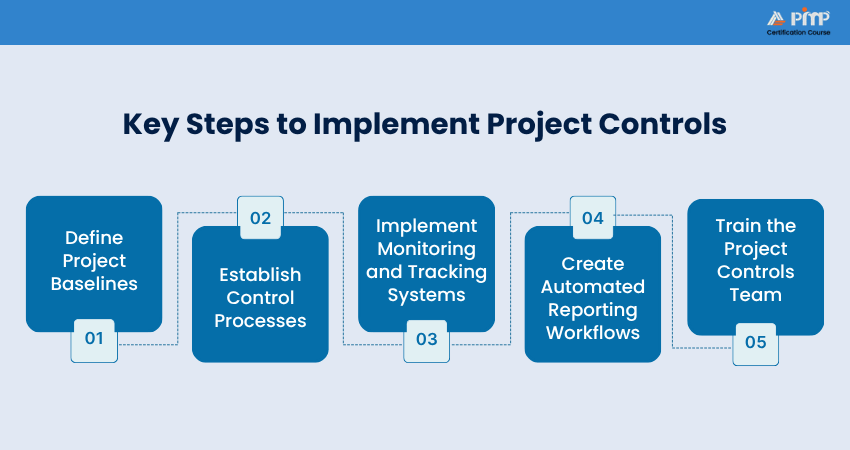
Step 1: Define Project Baselines
Project baselines serve as the reference point for measuring performance. Start off by outlining the project scope and deliverables. Next, develop a schedule that specifies when each deliverable will be completed. Finally, create a cost baseline that allocates the budget for all the project activities. Once approved, these baselines must only be modified through a formal change control process.
Step 2: Establish Control Processes
Define how the project's performance will be monitored, how deviations will be analyzed and how corrective actions will be implemented. It is also important to assign clear responsibilities such as identifying who gathers data, who analyses it and who makes decisions based on the results.
Step 3: Implement Monitoring and Tracking Systems
As projects grow in complexity, relying solely on manual tracking can become nearly impossible. Therefore, implement systems that automatically collect and present performance data. Choose platforms that integrate with existing tools and create dashboards that clearly display key metrics.
Step 4: Create Automated Reporting Workflows
Reporting must be timely. Automated workflows allow stakeholders to receive regular updates without any excessive manual effort. Create report formats tailored to different audiences. Also, automated distribution ensures consistent communication throughout the project lifecycle.
Step 5: Train the Project Controls Team
Continuous skill development is important for maintaining effective Project Controls. Teams must develop both technical expertise and the communication skills to present findings and recommendations clearly. Ongoing training and development ensure that the team can adapt to evolving Project Management practices.
Shape organizational success from the top. Sign up for our
Program Management Professional (PgMP)® Certification
and lead with impact!
Who Manages Project Controls in an Organization?
The management of Project Controls often depends on the size of the organization and the complexity of its projects. In smaller teams, a single professional may oversee it. In larger organizations, these responsibilities are usually distributed among specialized roles. Here are the main responsibilities:
1) Project Controller Responsibilities
A Project Controller serves as the analytical foundation of a project. They make sure that the performance data is analyzed and communicated effectively. Key responsibilities typically include:
a) Maintaining project schedules by monitoring milestones and tracking critical paths
b) Managing project budgets and comparing actual costs with planned forecasts
c) Analyzing performance data to identify trends, risks, and emerging issues
d)Investigating performance variances to understand deviations from expectations
e) Preparing forecasts and reports that outline progress and future projections
f) Converting complex analytical findings into clear insights for decision-makers
2) Project Controls Manager Responsibilities
A Project Controls Manager operates at a strategic level by overseeing Project Controls across multiple projects or programs rather than focusing on a single initiative. Key responsibilities include:
a) Developing methodologies and standards to ensure consistent application of Project Controls across the organization
b) Training and mentoring team members to strengthen their technical and analytical capabilities
c) Establishing processes and tools to improve data collection, analysis, and reporting
d) Coordinating across projects and programs to ensure alignment and share best practices
e) Acting as a bridge between project teams and executive leadership to support strategic decision-making
3) Building a Project Controls Team
The structure of a Project Controls team must reflect the needs of the organization's project portfolio. When designing this structure, consider the following factors:
a) Project Volume:
A higher number of projects may require more dedicated Project Controls resources.
b) Project Complexity:
Complex projects often demand specialized expertise and advanced monitoring methods.
c) Industry Requirements:
Certain industries require specific control frameworks or compliance measures.
d) Organizational Maturity:
More mature organizations may adopt more sophisticated Project Control systems.
Real-world Applications of Project Control
Organizations across various industries use advanced digital and cloud-based solutions to amplify their Project Control capabilities. The following examples highlight how proper Project Controls have helped companies improve their project delivery:
1) Dynetics
Dynetics is a commercial and defense contractor specializing in human spaceflight technologies. They strengthened their Project Controls within a well-integrated Earned Value Analysis (EVA) framework and strong project Management practices. This helps them gain real-time insights into project performance. As a result, the organization can consistently deliver projects to both Department of Defense (DoD) and commercial clients within budget and on schedule.
2) Northrop Grumman
In the Aerospace sector, Northrop Grumman implemented an integrated system which enabled it to conduct advanced schedule analysis and risk evaluations. Project teams could quickly identify critical path activities and bottlenecks. Thanks to these insights, Northrop Grumman strengthened its ability to fulfil contractual commitments and deliver complex aerospace projects.
3) CACI
CACI is a national security solutions provider. Beyond its traditional Earned Value Management (EVM) functions, the platform was used to support global Cost Management. The system consolidated three separate cost and pricing input platforms into a single solution. Processes that previously required several weeks were reduced to just a few days.
Kickstart your Project Management career with globally recognized CAPM® skills. Sign up for our
Certified Associate in Project Management (CAPM) ® Course
today!
Project Controls Examples
Project Controls involve a structured set of techniques and tools used to manage project performance. Below are several common examples of Project Controls used in real-world projects:
1) Project Baselines
A project baseline serves as a reference point used to measure and track project performance. It is typically established during the early stages of a project.
The three key baselines include:
a) Cost Baseline:
The planned project budget
b) Scope Baseline:
The defined project deliverables and requirements
c) Schedule Baseline:
The planned project timeline
2) Change Control Plan
A change control plan is part of a broader Project Control system that manages modifications throughout the project lifecycle. This process involves identifying, evaluating, approving, and implementing changes to project documents, deliverables or baselines.
It also ensures stakeholders are properly informed about updates and decisions. Change logs are often used to document and track all change requests until they are reviewed and approved by a change control board.
3) Risk Register
Risk Management is another essential Project Control technique. A risk register (or risk log) is used to identify, document, and monitor potential risks that could affect a project. It enables Project Managers to plan mitigation strategies in advance and prepare contingency actions if risks occur.
4) RACI Chart
A RACI chart is a Project Management tool that clarifies roles and responsibilities for each task within a project. It categorizes stakeholders as:
a) Responsible
b) Accountable
c) Consulted
d) Informed
This framework helps ensure clear ownership of tasks and improves communication across project teams.
5) Quality Management Plan
A Quality Management plan defines how quality standards will be maintained throughout the project. It outlines the processes, resources, and activities required to meet quality objectives and ensure deliverables meet expected standards.
6) Project Status Report
Project status reports help track project progress and keep stakeholders informed. These reports typically include information on task completion, costs, timelines, risks, and overall project performance. They allow Project Managers to identify issues early and make better decisions based on up-to-date project data.
7) Project Contracts
Contracts also function as Project Controls because they define obligations, responsibilities, and expectations between parties involved in the project. They help manage cost, schedule commitments, and risk through legally binding agreements.
8) Construction Work in Progress (WIP) Report
In construction projects, a Work in Progress (WIP) report is used to track project costs and monitor the spending across different phases. This report helps contractors evaluate project performance and manage financial risk.
Conclusion
Project Controls can turn the most complex projects into manageable journeys by bringing structure and accountability to every stage. By monitoring the costs, schedules, risks and performance, Project Managers receive the insights they need to make smarter decisions. When combined with strong leadership, these controls help teams stay on track, adapt to challenges, and deliver consistent, successful outcomes.
Stand out as a global project leader with our range of
Project Management Institute (PMI)® Certifications
. Sign up now!


 Back
Back

 Topics

 Courses


 10 Aug 2026
 Maria Thompson