Modern projects are full of uncertainty and constant changes as they progress. But what if you could still achieve structured and organized project execution in the middle of that chaos? All you need is a simple, Linear Project Management approach. Instead of reacting to change at every step, it provides a clear, step-by-step path from initiation to completion.
Each phase is completed before the next stage of your project begins, ensuring a structured and controlled workflow. In this blog, we will uncover what is Linear Project Management, its phases, benefits, and how you can apply it effectively to manage projects with greater clarity. Let's get started!
What is Linear Project Management?
Linear Project Management is a structured approach where a project progresses through a fixed sequence of phases. Each stage needs to be completed before the next one begins. There is a defined start, a defined end, and clearly assigned responsibilities throughout the project lifecycle.
This method is closely linked to the Waterfall model, which is commonly used in traditional project environments. It ensures that the project flows in one direction since all tasks are planned first, approved, and then executed step by step.

Key Features of Linear Project Management
To understand how Linear Project Management works in practice, it is important to look at its key features. They explain how it keeps projects controlled, predictable, and easier for teams to execute from start to finish. Here are the key features of Linear Project Management:
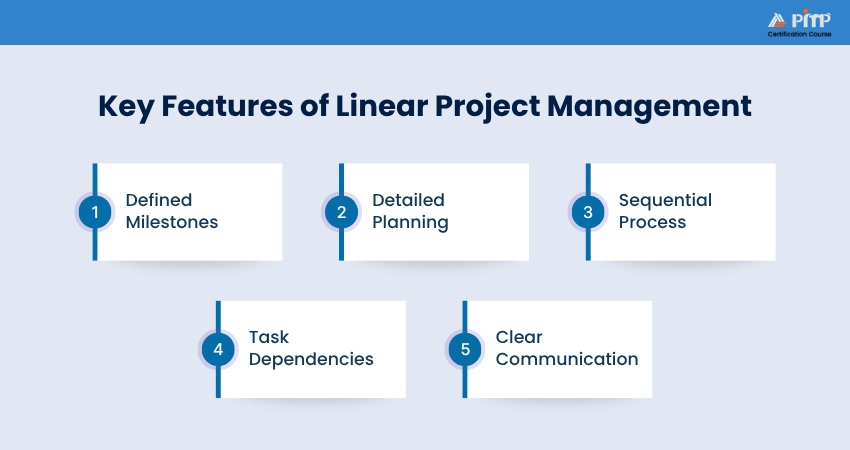
1) Defined Milestones
Milestones are checkpoints in a project. They show that a major part of the work has been finished. The team cannot begin the next phase of the project until the milestone is completed and validated. They help managers track progress, keep stakeholders informed, and prevent big mistakes from being unnoticed.
For example, in a construction project, foundation approval must happen before structural work begins. In a training programme, curriculum approval happens before course delivery.
2) Detailed Planning
Project planning is the backbone of Linear Project Management. Before execution starts, the team prepares a full project plan that usually includes project scope, timelines, resources, cost estimates, risk planning, and responsibilities. Everyone understands what needs to be done and when it has to be completed.
For example, in the construction project, architectural drawings, material lists, budget estimates, and timelines are prepared and approved before the actual work starts.
3) Sequential Process
A sequential process means tasks are completed in a fixed order. One stage finishes before the next one starts. The team does not jump between different stages at the same time. Because of this order, the project teams always know the next step. This reduces confusion in decision-making and makes coordination easier.
For example, in construction, the foundation is completed first, then the works for the structure, roofing, and installations are carried out, and finally interior finishing in a fixed order.
4) Task Dependencies
In Linear Project Management, many tasks may depend on other tasks. A task cannot begin until a previous one is completed. These relationships are called dependencies. Finding them in the early stages of a project prevents scheduling problems. Furthermore, Project Managers often create dependency charts to prevent scheduling conflicts.
For example, in the same construction project, electrical wiring cannot begin until the walls are properly built. So, they are properly organized when completed.
5) Clear Communication
Communication in Linear Projects is structured and planned rather than constant. Instead of continuous meetings, communication on project updates happens at predefined points such as project initiation, milestone reviews, status reporting, and final delivery. Clear communication keeps everyone aligned and supports smoother project execution.
For example, the construction team has review meetings after the building foundation and structure are completed to begin the next stage of work.
Strengthen your understanding of project fundamentals with
PMI Project Management Ready® Certification
– Register today!
5 Phases of Linear Project Management
Every Linear Project follows a clear phase of Project Management. These phases help teams track progress and deliver the project in a structured manner. Let's check those five phases:
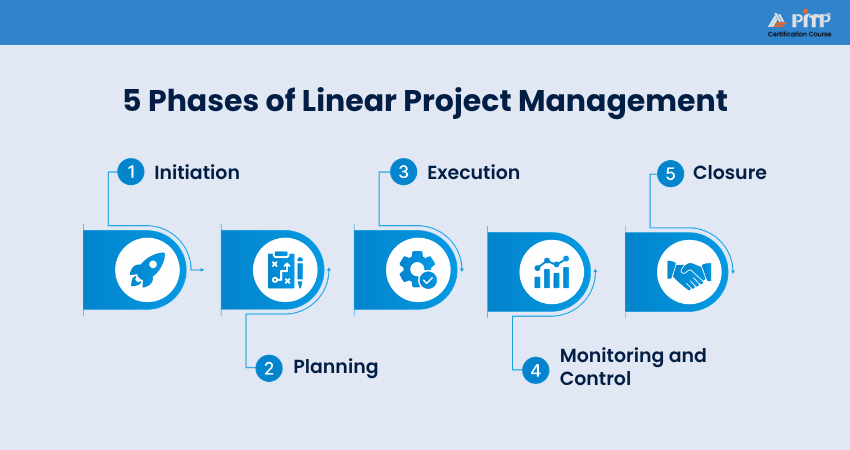
1) Initiation
This is the starting stage of the project. The main goal, purpose, and expected outcome are defined. Stakeholders are identified, and the project’s feasibility is reviewed. Important documents created in this phase may include:
1) Project charter
2) Stakeholder list
3) Business justification
4) Success criteria definition
2) Planning
Planning is the most important phase in Linear Project Management. Here, the team creates a detailed roadmap for how the project will be completed. The team prepares schedules, defines tasks, estimates the budget, and identifies risks. You might need to prepare:
1) Scope definition
2) Timeline and resource planning
3) Communication plan
4) Risk register
3) Execution
In the execution phase, the team performs the actual work. Tasks are carried out according to the approved plan and schedule. The focus during this stage is on productivity and following the planned workflow. During this phase, the team typically works on:
1) Task implementation
2) Resource coordination
3) Quality assurance activities
4) Deliverable development
4) Monitoring and Control
While the project is being executed, progress is continuously tracked. The Project Manager checks if the work is meeting deadlines, staying within budget, and maintaining quality standards. Frequent checks are done for:
1) Schedule variance
2) Cost usage
3) Project performance
4) Risks
5) Closure
Closure is the final stage of the project. All work is completed and formally approved by stakeholders. This stage is important because it confirms that all goals have been met. The team also records lessons learned to improve future projects. The closure activities include:
1) Final delivery approval
2) Documentation handover
3) Financial closure
4) Lessons learned review
Why is Linear Project Management Perfect?
Linear Project Management is effective when a project needs structure, clarity, and predictable delivery. Below are some reasons why many businesses find this approach perfect for their projects:
1) Speed
At first glance, Linear Project Management may appear slow because of planning. In reality, they often deliver faster. Teams avoid constant rework, which is one of the biggest hidden delays in projects. Completing each stage once saves time and helps projects finish on schedule.
2) Focus
Team members work on one defined project phase at a time. They are not switching between incomplete tasks. This increases productivity and reduces mental overload. Many teams report improved quality because they can concentrate fully on one task, and this has significantly enhanced productivity.
3) Scalability
Linear Project Management works well for both small and large projects. When many departments or stakeholders are involved, the structured process keeps work organized, without any confusion. Clear roles, timelines, and approvals make coordination easier across bigger teams.
4) For Developers
Developers benefit from clear requirements and linear workflows for structured releases. They can build features based on approved specifications without frequent changes. This reduces confusion, prevents technical issues, avoids last-minute changes, and makes testing and deployment more manageable.
Explore various project frameworks, processes, and best practices with
Certified Associate in Project Management (CAPM) ® Training
– Sign up soon!
Linear Project vs Non-linear Project
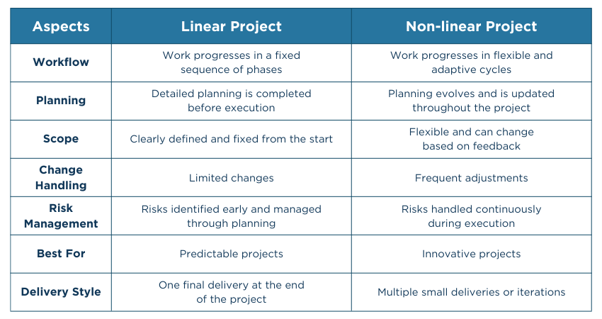
Projects can be managed in different ways depending on the type of work, level of uncertainty, and flexibility required. A Linear Project follows a step-by-step structure. However, a non-linear project allows flexibility. Tasks may run simultaneously, and plans can evolve during execution. Teams can revisit earlier stages if requirements change.
Understanding their differences helps organizations choose the right method for their needs. So, below is a table, explaining how Linear Project and non-linear project differ:
Linear Project vs Non-linear Project
Linear Project Management offers several benefits since work follows in a structured order, and creative tasks are executed with fewer unexpected issues. The following are the Benefits of Linear Project Management:
1) Clear Project Structure
The project is divided into defined phases, making it easy for everyone to understand the workflow and what comes next. This also helps new team members quickly understand their tasks and responsibilities.
2) Better Schedule Control
Since tasks follow a sequence, timelines are easier to estimate and manage. Managers can track progress more accurately. It becomes simpler to identify delays and take corrective action early.
3) Strong Accountability
Roles and responsibilities are clearly assigned to all team members. So, everyone knows their duties, which reduces confusion and delays. Clear ownership also improves individual performance and teamwork.
4) Consistent Quality
Because each phase is reviewed before moving forward, errors are detected earlier, and the final deliverable meets expected standards. Quality checks at each stage reduce the need for major rework later.
5) Improved Cost Management
A fixed scope allows better budgeting. With fewer changes, the project is less likely to exceed its planned costs. This helps organizations control expenses and allocate resources efficiently.
Limitations of Linear Project Management
Linear Project Management has its own limitations that teams must understand before adopting it. Those include the following:
1) Sequential Nature
Because tasks are completed one after another, a delay in one stage affects the entire project timeline. For example, a late approval can stop all remaining work until the previous step is finished.
2) Comprehensive Planning
This approach requires extensive planning at the beginning. Teams need to spend more time defining scope, timelines, and resources before starting, which may feel slow for businesses that prefer quick action.
3) Inflexibility
Linear Projects are not designed for frequent changes. If requirements change during the project, adjustments can be costly and time-consuming. Teams may need to revisit earlier phases and redo completed work.
How to Use and Get Started With Linear Project Management Tools?
Many teams today implement linear workflows using dedicated Project Management platforms. So, let’s now check how to start using the Linear Project Management tools:
1) Sign up and Create an Account
Start by choosing a Project Management tool and creating an organizational account. Invite your team members so that everyone can access the same workspace. This keeps tasks, communication, and updates in one place instead of scattered across emails or chats.
2) Set up Your Workspace
After signing up, organize your workspace by setting up a workspace name and creating teams, departments, and roles. Assign permissions so only authorized members can edit or approve tasks. A well-structured workspace prevents confusion later.
3) Create Your First Project
Create a new project and define the project name, objective, owner, start date, and deadline. Then divide the project into phases such as initiation, planning, execution, and closure. This becomes the roadmap for your project.
4) Add Issues
Issues represent the tasks that need to be completed. For each issue, include a clear description, a responsible person, a priority level, a due date, and any dependencies. Properly defined tasks help the team understand what needs to be done.
5) Integrate With Other Tools
You can integrate the platform with other tools your team uses, such as communication apps, documentation systems, or code repositories. Integration reduces manual updates and improves visibility across teams.
6) Explore Advanced Features
Once the basic setup is complete, use advanced features like automation rules, workflow statuses, dashboards, and reporting. These features help managers track progress, monitor performance, and manage projects more efficiently.
Linear Project Management Examples
Now, let’s check some of the real-world examples of Linear Project Management:
1) Event Management Project
For a corporate event, the team selects the venue, plans the schedule, arranges vendors, promotes the event, conducts the event, and then reviews feedback. Each activity happens in order to avoid last-minute problems.
2) Manufacturing Product Launch
A manufacturer first designs the product, creates a prototype, tests it, begins production, performs quality checks, and then distributes it to the market. Production only starts after testing approval.
3) Website Development Project
A business working on website development first gathers requirements, then designs the website layout, develops the pages, tests the website, and finally launches it. The site is not published until testing is completed.
4) Software Release With Fixed Scope
In a planned software release, the team first finalizes requirements. Developers then build the features, testers check for errors, issues are fixed, and the software is released only after successful testing.
Conclusion
Linear Project Management continues to prove its value in a world where projects often feel unpredictable. While many teams prefer flexible methods, a structured, step-by-step approach still delivers strong results when goals, scope, and timelines are clearly defined. When used in the right context, it helps teams stay focused, minimize risks, and complete projects with confidence.
Start building structured project skills with
Project Management Institute (PMI)® Certification
– Join now!


 Back
Back

 Topics

 Courses


 10 Aug 2026

 David Walter