You can have the perfect plan, timeline and budget but if people don’t embrace the change, it still won’t work. Projects may be delivered successfully yet fail to create a real impact because employees are not ready to accept or adopt the change. This is where the difference between Change Management and Project Management becomes important.
While Project Management focuses on delivering tasks and achieving defined goals, Change Management ensures that employees are prepared and willing to make the change. In this blog, we will explore Change Management vs Project Management and see how both approaches work together to drive lasting business outcomes. Let's get started!
What is Change Management?
Change Management is a step-by-step approach that helps people adjust to changes in their workplace. It focuses on the human side of transformation and makes sure employees understand the purpose, impact, and nature of the change.
The main goal of Change Management is to reduce confusion and resistance. When people feel informed and supported through clear communication and proper training, they are more likely to accept change. This makes the transition smoother and more successful.
Role of a Change Manager
A Change Manager plays an important role in bridging the gap between strategy and people. The following are their roles and responsibilities:
1) Develop and implement Change Management strategies and plans
2) Communicate the purpose and benefits of change to employees
3) Identify and manage resistance to change
4) Conduct stakeholder analysis and engagement
5) Organize training sessions to help employees adapt
6) Provide support and guidance during transitions
7) Work closely with leadership to align change with business goals
8) Monitor adoption and measure the success of change initiatives

What is Project Management?
Project Management is the process of planning, organizing, and delivering projects within defined constraints such as time, scope, and budget. It focuses on achieving specific objectives and producing tangible outcomes.
A project typically has a clear start and end point, along with specific goals or deliverables. Project Management ensures that all tasks are completed in a structured way, resources are allocated properly, and risks are managed effectively.
Role of a Project Manager
A Project Manager is responsible for overseeing the entire project lifecycle. Let's check their role in an organization:
1) Plan and define project scope, goals, and deliverables
2) Create project timelines and schedules
3) Assign tasks to team members while managing resources
4) Monitor project progress to ensure timely task completion
5) Identify risks and develop mitigation strategies
6) Communicate with stakeholders and provide regular updates
7) Coordinate team activities and ensure collaboration
8) Ensure the project meets quality standards and objectives
Change Management vs Project Management: Key Difference
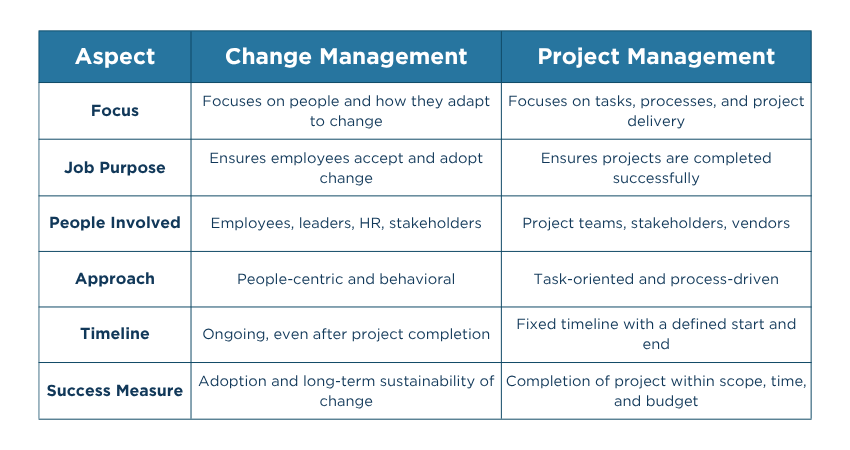
Although Change Management and Project Management are closely related, they are used in different ways. Let's check how they differ from each other:
1) Job Purpose
The main purpose of Change Management is to ensure that people adopt and embrace change. It focuses on behavior, mindset, and how people feel about new ways of working.
Project Management, on the other hand, focuses on completing tasks and delivering results. Its goal is to finish a project on time, within budget, and as planned with required quality standards.
2) Involved Parties
Change Management involves many people across the organization. This includes employees, managers, Human Resources (HR) teams, technical experts, and communication specialists. It focuses on those who will be affected by the change.
On the contrary, Project Management mainly involves project teams, stakeholders, and sometimes external vendors. It focuses more on delivering the project work efficiently.
Learn practical Project Management concepts with
Certified Associate in Project Management (CAPM) ® Training
– Register today!
3) Primary Responsibilities
Change Management is mainly concerned with supporting people through the transition. Change Managers are responsible for communication, training, and helping people deal with change. They ensure that employees are able to adopt new ways of working.
Meanwhile, Project Managers handle planning, scheduling, and resource management. They ensure that tasks are completed according to the defined scope and objectives, keeping the project on track from start to finish.
4) Required Training
Change Managers often have backgrounds in organizational development, communications, Human Resources, business transformation, or related people-focused roles. Thus, their training can focus on understanding how people respond to change and how to guide them through it effectively.
Project Managers typically need training in Project Management methodologies and may hold certifications like PMP or Scrum. They focus on planning, execution, and structured ways to manage projects.
5) Salary
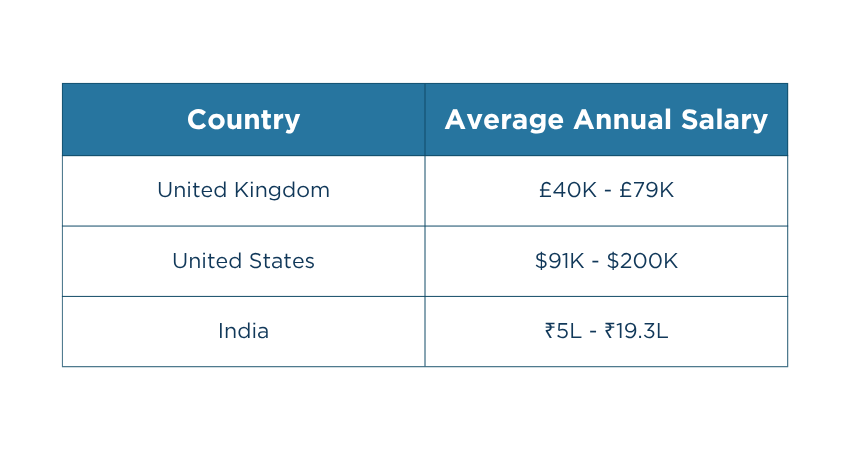
Salaries for both roles can differ based on experience, industry, and location. Change Managers, being a more specialized role, can command competitive salaries, especially in organizations undergoing significant transformation. Let's check the average salary they can earn in different locations:
Source:
Glassdoor
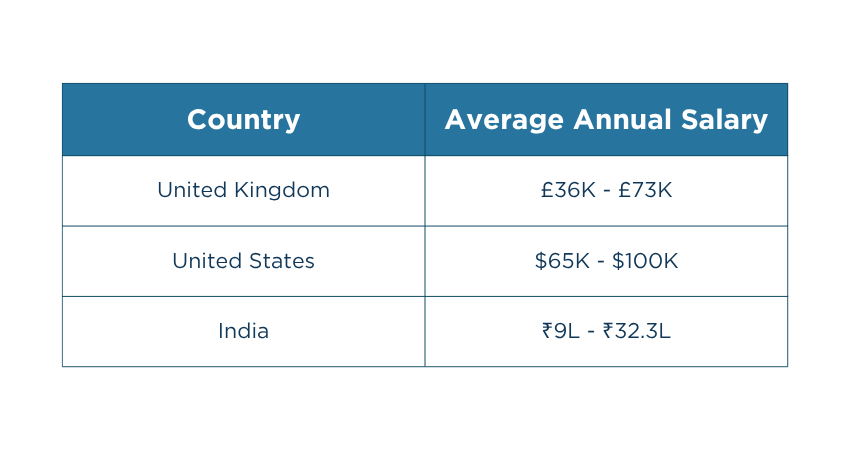
In general, Project Managers also have a well-established salary range as the role has been established for a long time. Let's check their salary range across different locations:
Source:
Glassdoor
Similarities Between Change Management and Project Management
Despite their differences, Change Management and Project Management also have many similarities. Both play an important role in helping organizations grow and improve. The similarities include:
1) Shared Objectives
Both aim to achieve successful outcomes for the organization. While their approaches differ, they both focus highly on improving performance and helping the company reach its goals. Whether it is a new system or a process improvement, both approaches support the organization's strategy.
2) Collaborative Approaches
Collaboration is a key element in both Change and Project Management. Teams need to work together, communicate effectively, and remain aligned throughout the process. To achieve this, Change Managers and Project Managers often work closely. While one focuses on people and the other on tasks, both are needed to make a project truly successful.
Prepare for real-world projects and change initiatives with
PMI Project Management Ready® Certification
– Join now!
3) Interdisciplinary Skills
Both roles require a diverse set of skills, including communication, leadership, problem-solving, and stakeholder management. These skills help professionals handle challenges and work effectively with others. Plans may change, and unexpected issues can arise, so both roles must be ready to adapt when needed.
Conclusion
Change Management vs Project Management may seem similar, but they play very different roles. Businesses that rely only on project delivery often struggle to see long-term impact, as change is not fully adopted. Similarly, focusing only on people without a clear execution plan can slow progress. This is why a balanced approach is essential. Instead of choosing one over the other, it is better to combine them and increase the project's success rate.
Shift from managing tasks to leading successful projects with the
Project Management Institute (PMI)® Certification
– Sign up soon!


 Back
Back

 Topics

 Courses


 10 Aug 2026
 Grace Mitchell