Are you curious about what it takes to become a Program Manager? You are in the right place! A Program Manager is responsible for coordinating projects to achieve strategic business objectives. In this blog, we discuss the essential skills, education, and steps needed for “How to Become a Program Manager.”
Whether you’re just starting your career or looking to make a switch, we have practical advice and insights to help you on your journey. Ready to explore the path to this rewarding role? Let’s get started!
Table of Contents
1) What is a Program Manager?
2) Key Responsibilities of Program Manager
3) Essential Skills Required to be a Program Manager
4) How to Become a Program Manager?
5) Average Salary of Program Manager
6) Preparing for a Program Manager Interview
7) Conclusion
What is a Program Manager?
A Program Manager is responsible for organizing, planning, and coordinating various projects within a company or institution. This role can cover different types of programs, giving professionals a wide range of fields to choose from.
Key Points:
a) Organizing, planning, and coordinating various projects within a company or institution.
b) Acting as the connection between the company and its clients.
c) Overseeing and managing activities related to user and company interactions.
d) Covers different types of programs, offering a wide range of fields to choose from.
e) Clear and confident communication.
f) Knowledge of finance, IT systems, and data science.
Key Responsibilities of Program Manager
A Program Manager oversees multiple related projects that all contribute to a larger company goal or objective. They design the overall program, manage budgets, and track the progress of each project.
Key responsibilities of a Program Manager include:
a) Leading teams and Project Managers from various departments
b) Creating strategic plans and tracking progress
c) Overseeing related projects
d) Managing budgets, deadlines, and targets
e) Developing a roadmap to link projects to the overall program
f) Clearly communicating goals and directions
g) Evaluating program performance
h) Preparing reports for program directors
Essential Skills Required to be a Program Manager
A successful Program Manager needs several key skills. Here are the most important skills in the industry today:
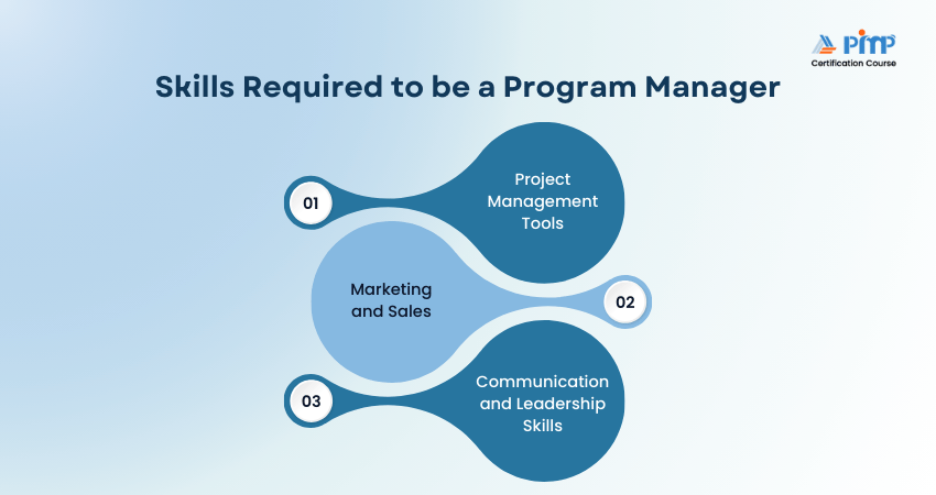
a) Project Management Tools:
As a Program Manager, you will use Project Management software daily. Some popular tools to familiarize yourself with are ClickUp, Trello, Planio, and Asana.
b) Marketing and Sales:
In this role, you need to apply marketing and sales knowledge to meet customer goals. An MBA can be helpful for learning techniques in this field. The more you know about sales planning, events, trading strategies, and customer acquisition, the better.
c) Communication and Leadership Skills:
Maintaining positive team dynamics is crucial. Program Managers ensure everyone gets along and stays motivated. Use your interpersonal skills to create a good environment and keep your spirits high. Effective communication also helps solve problems quickly.
How to Become a Program Manager?
A career in Program Management is competitive and requires a good level of education, experience, and progression within the industry. Here are the steps that can help you build a successful career in Program Management.
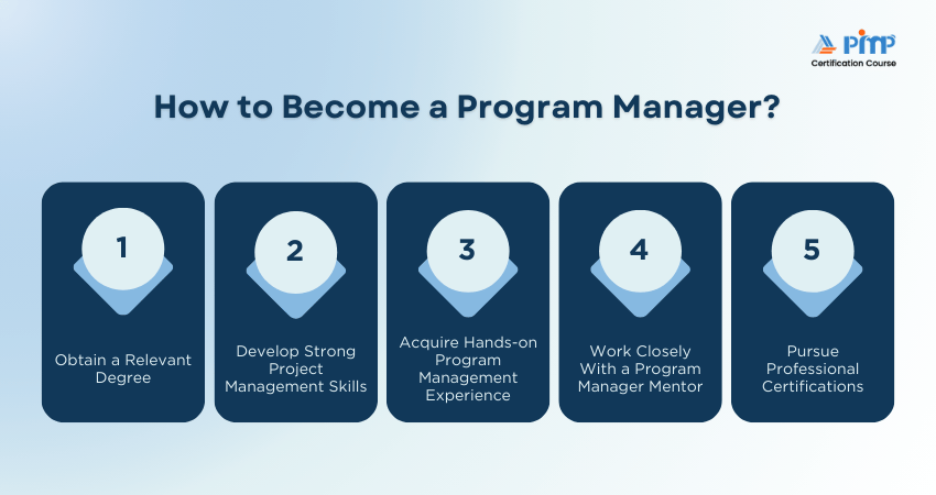
1) Obtain a Relevant Degree
a) Entry-Level Requirement:
An undergraduate degree is typically the minimum requirement for a Program Management position.
b) Educational Statistics:
a) 66% of Program Managers hold a bachelor’s degree.
b) 19% hold a master’s degree (source: Zippia).
c) Field of Study:
The degree should align with the desired job market or be in areas such as business, management, or business administration.
d) Advanced Degrees:
A master’s degree can enhance employment opportunities and salary potential.
2) Develop Strong Project Management Skills
To become a Program Manager, you need a background in Project Management and industry experience. Starting as a Project Manager helps you gain experience in:
a) Leading teams
b) Prioritizing tasks
c) Understanding project timelines
d) Using project Management software
e) Budgeting projects
f) Managing business processes
3) Acquire Hands-on Program Management Experience
If you’re new to this field, apply for junior-level Program Management positions to gain relevant experience. This experience will help you move up to more senior roles. Senior Program Managers are highly experienced and have proven their skills through successful projects and programs. If you’re already a Project Manager, treat your projects as programs by structuring the work of junior Project Managers as mini-projects.
4) Work Closely With a Program Manager Mentor
Having a mentor with experience in Program Management can be invaluable. A mentor can help you:
a) Understand the role
b) Learn the path to entering the role
c) Evaluate your skills and find areas for improvement
d) Create a vision for your career
5) Pursue Professional Certifications
Certifications can enhance your qualifications and help you stand out. Some jobs may require specific certifications. Consider the following:
a) Certified Lean Six Sigma Green Belt (ICGB)
b) Federal Acquisition Certification for Program and Project Managers (FAC-P/PM)
c) Program Management Professional (PgMP)
d) Project Management Professional (PMP)
Kickstart your Project Management journey with our
Certified Associate in Project Management (CAPM) ® Training
– Join now!
Average Salary of Program Manager
According to the US Bureau of Labor Statistics (BLS), Project Management specialists earn an average annual salary of $84,290. The BLS also predicts that management jobs will grow by five percent from 2019 to 2029. This means that if you pursue a career in Project Management, you will have a bright future with many job opportunities across various industries.
Preparing for a Program Manager Interview
Preparing for a Program Manager interview involves several steps to show your expertise, experience, and skills. Here’s a simple tips to help you get ready:
1) Conduct Thorough Company Research
a) Understand the Business:
Learn about the company’s mission, values, products, services, and market position. Know its strategic goals and recent achievements.
b) Company Culture:
Find out about the company culture to see if it matches your values and work style.
2) Familiarize Yourself With the Role
a) Job Description:
Study the job description to identify key responsibilities and required skills. Understand what the role expects and the specific projects or programs you might manage.
b) Key Competencies:
Focus on core skills needed for a Program Manager, like leadership, strategic planning, risk management, and communication with stakeholders.
3) Update and Refine Your Resume and Portfolio
a) Tailor Your Resume:
Change your resume to highlight relevant experiences and achievements that match the job description. Emphasize your Program Management successes, leadership roles, and completed projects.
b) Portfolio:
Create a list of projects you have managed, including case studies, project plans, budgets, timelines, and outcomes. Use this to showcase your skills and successes.
4) Review Essential Concepts
a) Program Management Principles:
Review important concepts like program lifecycle, benefits realization, program governance, and resource management.
b) Project Management Tools:
Be familiar with tools and software like Microsoft Project, JIRA, and Asana, and understand how they can be used in Program Management.
5) Practice Answering Behavioral Questions
STAR Method:
Practice answering behavioral questions using the STAR method (Situation, Task, Action, Result). This helps you structure your responses clearly and concisely.
Common Questions to Prepare For:
a) Describe a successful program you managed.
b) How do you manage conflicts between project teams?
c) How do you prioritize and manage resources across multiple projects?
d) Give an example of a risk you identified and mitigated in a program.
e) How do you ensure the alignment of projects within a program to strategic objectives?
Advance your agile skills with our
PMI-ACP® Certification Training
– Join now to lead agile projects like a pro!
Conclusion
A Program Manager is essential for overseeing multiple projects and making sure they align with business goals. To be successful, they need strong leadership, communication, and problem-solving skills. Understanding the key responsibilities and developing these skills are important steps in this career. If you are interested in this role, learning How to Become a Program Manager will help you get started and guide you toward a rewarding career with great growth opportunities.
Boost your project management career with
PMP® Certification Training
– Join today and lead with confidence!

 Back
Back

 Topics

 Courses


 10 Aug 2026
 David Walter