Would you buy a car that was delivered exactly on schedule but had faulty brakes? Most people wouldn't. The same principle applies to projects. No matter how quickly a project is completed, poor quality can make the entire effort unsuccessful. This is why Project Quality Management is a critical part of project success.
It helps teams establish quality standards throughout the project lifecycle and achieve better project outcomes. In this blog, we will explore what is Project Quality Management, why it is important, its key processes, benefits and practical examples of how it contributes to high-quality project results. Let's get started!
What is Project Quality Management?
Project Quality Management is the process of planning, managing and controlling quality throughout a project's lifecycle to ensure that deliverables meet specified requirements and stakeholder expectations. Its goal is not only to identify defects but also to prevent them from occurring.
Project Quality Management focuses on both the quality of the project processes and the final deliverables. Whether a project involves software development, construction, manufacturing or service delivery, maintaining quality is essential for project success.
Importance of Project Quality Management
Project Quality Management is essential because it helps ensure that project deliverables meet stakeholder expectations and fulfill their intended purpose. Regardless of the project's size or industry, maintaining quality throughout the project lifecycle reduces the chances of defects, delays and costly rework.
By establishing clear quality standards and monitoring performance, teams can deliver consistent results while improving overall project efficiency. Quality Management also plays a key role in building customer trust and satisfaction.
Benefits of Project Quality Management
Project Quality Management provides significant benefits for organizations, project teams and stakeholders. Some of the key benefits of implementing it include:
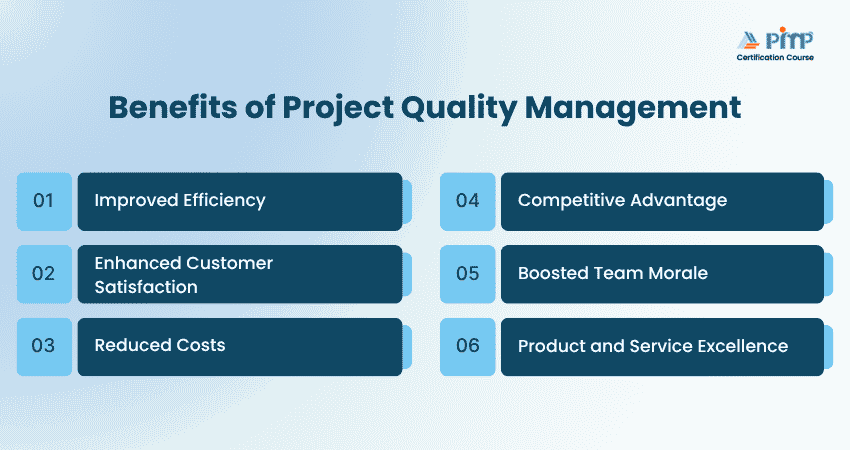
1) Improved Efficiency
Project Quality Management helps teams follow clear processes and standards, reducing errors, delays and unnecessary rework. This enables resources to be used effectively and improves overall productivity throughout the project lifecycle.
2) Enhanced Customer Satisfaction
Delivering high-quality products, services or solutions that meet stakeholder requirements helps improve customer satisfaction. Satisfied customers are more likely to trust the organization, remain loyal and recommend its offerings to others.
3) Reduced Costs
By identifying and preventing quality issues early, organizations can minimize defects, rework and project delays. This helps reduce overall project costs and supports the more effective use of budgets and resources.
4) Competitive Advantage
Consistently delivering quality outcomes helps organizations build a strong reputation and gain customer trust. This can differentiate them from competitors and strengthen their position in the marketplace, which can lead to long-term business success.
5) Boosted Team Morale
Clear quality standards and fewer project issues create a more positive working environment for employees. Reducing rework and avoiding repeated mistakes also helps lower their stress levels. As a result, team members feel more motivated when they contribute to successful project outcomes.
6) Product and Service Excellence
Project Quality Management encourages continuous improvement and a focus on delivering the best possible outcomes. By monitoring performance and refining processes, organizations can consistently enhance the quality of their products and services.
Challenges of Project Quality Management
While Project Quality Management offers numerous benefits, organizations may face some challenges when implementing and maintaining quality standards. Those may include:
1) Tight Deadlines and Budget Pressures:
Project teams often work under strict schedules and limited budgets, making it difficult to maintain quality without compromising project constraints.
2) Frequent Changes in Requirements:
Changing stakeholder expectations or project scope can disrupt quality plans and create inconsistencies in deliverables.
3) Lack of Skilled Resources:
Insufficient expertise, training or dedicated quality personnel can affect the effectiveness of Quality Management activities.
4) Resistance to Quality Processes:
Employees and stakeholders may be reluctant to adopt new quality standards, procedures, or improvement initiatives.
5) Communication Gaps:
Poor communication between teams and stakeholders can result in misunderstandings, errors and unmet quality expectations.
6) Difficulty Measuring Quality Performance:
Some quality requirements are difficult to define or measure, making it challenging to evaluate whether standards are being achieved.
7) Managing Quality in Complex Projects:
Coordinating quality activities across multiple teams, departments or locations can increase complexity and the risk of inconsistencies.
Learn essential Project Management concepts and best practices with
PMI Project Management Ready® Certification Training
– Register today!
How to Implement Project Quality Management?
Quality cannot be achieved through inspections alone. It must be built into every phase of a project, from planning to delivery. Here are the steps to implement Project Quality Management:
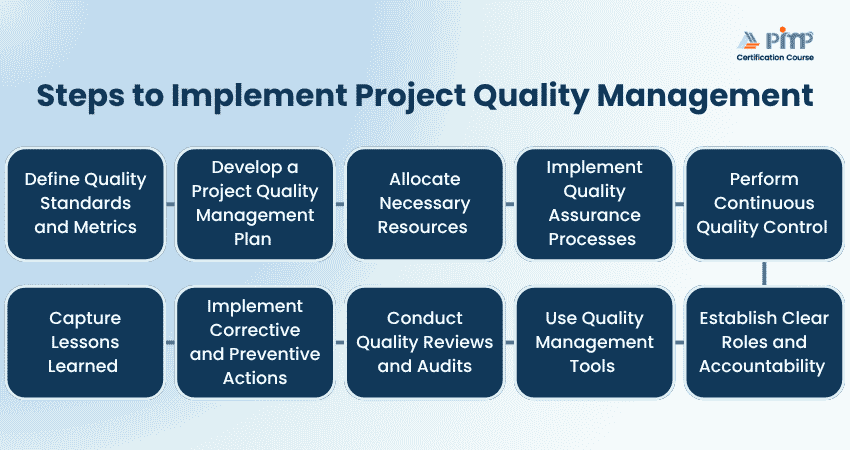
1) Define Quality Standards and Metrics
The first step is to find the quality standards, requirements and expectations that the project must meet. Teams should also establish measurable metrics and performance indicators to evaluate quality throughout the project lifecycle.
2) Develop a Project Quality Management Plan
A Quality Management Plan outlines how quality will be planned, managed, monitored, and controlled during the project. It should define quality objectives, responsibilities, processes, tools and reporting methods to ensure a consistent approach to Quality Management.
3) Allocate Necessary Resources
Successful Quality Management requires adequate resources, including skilled personnel, training, tools and budget. Ensuring these resources are available helps teams implement quality activities effectively and maintain required standards.
4) Implement Quality Assurance Processes
Quality Assurance (QA) focuses on preventing defects by ensuring that project processes are followed correctly. Activities such as audits, process reviews and staff training help improve consistency and support continuous process improvement.
5) Perform Continuous Quality Control
Quality control involves regularly reviewing project deliverables to verify that they meet established standards. Inspections, testing and performance monitoring help identify issues early and allow corrective actions to be taken promptly.
6) Establish Clear Roles and Accountability
Every team member should understand their responsibilities related to Quality Management. Clearly defined roles improve accountability, encourage ownership and ensure that quality objectives are consistently supported across the project.
7) Use Quality Management Tools
Project teams should use appropriate Quality Management tools and techniques, such as checklists, control charts, Pareto charts and root cause analysis. These tools help monitor performance, identify issues and support data-driven decision-making.
8) Conduct Quality Reviews and Audits
Regular quality reviews and audits help evaluate whether project activities comply with established standards and procedures. They also provide opportunities to identify improvement areas and strengthen Quality Management practices.
9) Implement Corrective and Preventive Actions
When quality issues are identified, corrective actions should be taken to resolve them quickly. At the same time, preventive actions should also be implemented to address potential risks and reduce the chances of the same issues occurring in the future.
10) Capture Lessons Learned
At different stages of the project, teams should document lessons learned related to quality performance, challenges and successes. These insights can be used to improve future projects and support continuous organizational learning.
Elevate your commitment to professional Project Management practices with
Certified Associate in Project Management (CAPM) ® Training
– Sign up soon!
Project Quality Management Tools and Techniques
Project Quality Management relies on various tools and techniques to help teams monitor performance, identify issues, analyze root causes and maintain quality standards throughout a project. Here are some of the widely used tools and techniques:
1) Cause and Effect Diagrams
Commonly known as Fishbone Diagrams or Ishikawa Diagrams, cause and effect diagrams help identify the root causes of quality problems. By categorizing potential causes into areas such as people, processes, materials and equipment, teams can systematically investigate issues and develop effective solutions.
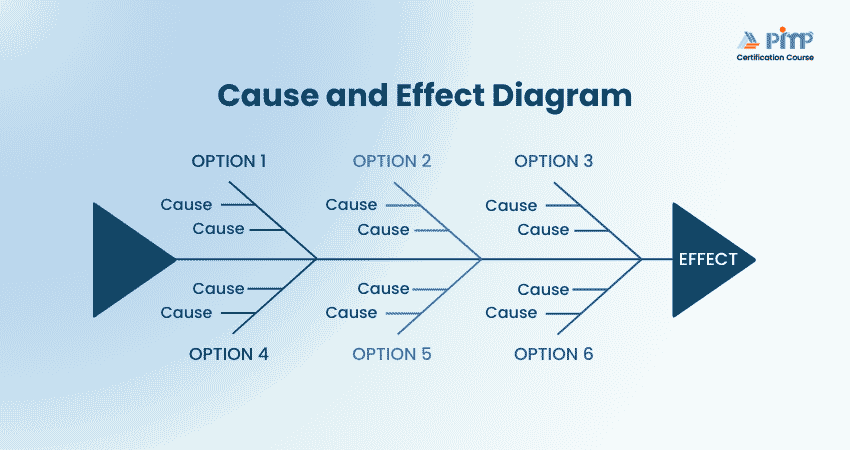
This visual approach makes it easier to analyze complex issues and find the factors contributing to quality issues. Thus, by identifying root causes rather than treating symptoms, teams can implement more effective and long-lasting solutions.
2) Control Charts
Control charts are graphical tools to track and monitor process performance over time. They display data against predefined upper and lower control limits, helping teams determine whether a process is stable and operating within expected variation.
These charts allow Project Managers to identify unusual variations, detect potential quality issues early and take corrective action before problems affect project outcomes. Control Charts are particularly useful for maintaining consistency and improving process stability.
3) Flowcharts
Flowcharts visually represent the sequence of activities within a process. They help project teams understand how work flows from one stage to another and identify areas where inefficiencies or errors may occur.
By mapping processes clearly, teams can improve communication, simplify complex workflows and identify opportunities for process improvement. Flowcharts are commonly used during quality planning and process analysis activities.
4) Checklists
Checklists are simple yet highly effective tools that ensure important tasks, requirements and quality standards are not overlooked. They provide a structured method for verifying that specific activities have been completed correctly.
Project teams often use checklists during inspections, audits and testing activities to maintain consistency and reduce the likelihood of errors. Their simplicity makes them one of the most widely used Project Quality Management tools across industries.
5) Histograms
Histograms are bar charts that display the distribution of data within a process. They help teams understand patterns, trends and variations by showing how frequently different values occur.
In Project Quality Management, histograms are useful for analyzing performance data, identifying recurring issues and determining whether processes are operating within expected ranges. They provide a clear visual representation of data that supports better decision-making.
6) Pareto Charts
Pareto Charts help teams identify the most significant factors contributing to quality issues. Based on the Pareto Principle, which is known as the 80/20 rule, these charts suggest that a small number of causes are often responsible for the majority of problems.
By highlighting the issues with the greatest impact, Pareto Charts allow project teams to prioritize improvement efforts and focus resources where they can achieve the most meaningful results.
7) Six Sigma
Six Sigma is a data-driven Quality Management methodology designed to reduce defects and improve process performance. It focuses on identifying sources of variation and eliminating factors that negatively affect quality.
Using a structured approach such as Define, Measure, Analyze, Improve and Control (DMAIC), Six Sigma helps organizations improve efficiency, reduce waste and achieve consistent results. It is widely used in industries where precision and reliability are critical.
8) Total Quality Management (TQM)
Total Quality Management (TQM) is an organization-wide approach that focuses on continuous improvement and customer satisfaction. It encourages all employees to contribute to quality initiatives and process improvements.
TQM promotes a culture where quality is embedded into every activity and decision. By emphasizing teamwork, customer focus and ongoing improvement, organizations can enhance performance, improve product and service quality, and achieve long-term business success.
Project Quality Management Examples
Project Quality Management can be applied across different industries to ensure that deliverables meet quality standards. The following examples show how Quality Management contributes to successful project outcomes in various project environments:
1) Software Development Project
A software company involved in developing a mobile banking application establishes quality requirements for security, functionality and performance. The project team conducts code reviews, software testing and user acceptance testing throughout development. By identifying and resolving defects before launch, the company delivers a reliable and secure application that meets customer expectations.
2) Construction Project
A construction company building a commercial office complex implements quality inspections at every stage of the project. Materials are tested, safety standards are monitored and regular site audits are conducted to ensure compliance with building regulations. These quality measures help prevent structural issues and ensure the building meets required standards.
3) Product Manufacturing Project
A manufacturing company launching a new electronic device uses quality control checks throughout the production process. Components are inspected, products are tested for performance and defects are tracked and analyzed. This approach helps maintain product consistency, reduce waste and deliver high-quality products to customers.
4) Healthcare System Implementation Project
A hospital introducing a new patient management system establishes quality standards for data accuracy, security and system performance. The project team performs extensive testing, staff training and process reviews before deployment. As a result, the hospital successfully introduced a reliable system that improved operational efficiency and patient care.
Conclusion
Project Quality Management is more than just a process for identifying defects. It is a strategic approach to ensuring that projects deliver value and achieve their intended objectives. By focusing on quality planning, assurance and control, organizations can improve overall project performance and build a strong foundation for long-term growth.
Start validating your Project Management skills with
Project Management Institute (PMI)® Certification Training
– Join now!


 Back
Back

 Topics

 Courses


 10 Aug 2026

 Maria Thompson