Choosing the right Project Management Certification can be challenging, especially when deciding between two prominent options: PMP vs PRINCE2. Have you been wondering which certification better aligns with your career goals? Whether you want to specialize in an industry or become a versatile Project Manager, the decision you make will impact your career.
In this blog, we'll break down the key differences between PMP and PRINCE2, including their methodologies, frameworks, and industry relevance. If you're on the fence about choosing between PMP vs PRINCE2, let's dive into the details and help you make an informed choice.
Table of Contents
1) What is a PMP® Certification?
2) What is a PRINCE2® Certification?
3) Key Differences Between PMP and PRINCE2
4) PRINCE2 vs PMP Certification: Which Is More Challenging?
5) Benefits of Getting a PRINCE2® vs PMP® Certification
6) Tips for Choosing Between PRINCE2 and PMP Certifications
7) Conclusion
What is a PMP® Certification?
PMP® (Project Management Professional) is a globally recognized Project Management certification awarded by the Project Management Institute (PMI). It validates a professional's ability to lead and manage projects across a wide range of industries using predictive, Agile, and hybrid approaches.
Earning a PMP® Certification demonstrates advanced Project Management knowledge, practical experience, and the ability to deliver successful projects while meeting organizational objectives. It is widely valued by employers seeking experienced Project Managers capable of managing complex projects and leading high-performing teams.

What is a PRINCE2® Certification?
PRINCE2® Certification validates your knowledge of the PRINCE2 (PRojects IN Controlled Environments) Project Management methodology. It provides a structured approach to planning, managing, and delivering projects by dividing them into manageable stages. This helps teams manage resources, reduce risks, and deliver projects efficiently across different industries.
PRINCE2 also defines clear roles and responsibilities, improving communication and accountability throughout the project lifecycle. Its scalable framework makes it suitable for both public and private sector organizations. Widely recognized in the UK and internationally, PRINCE2 is administered by PeopleCert and is trusted across a wide range of industries.
Key Differences Between PMP and PRINCE2
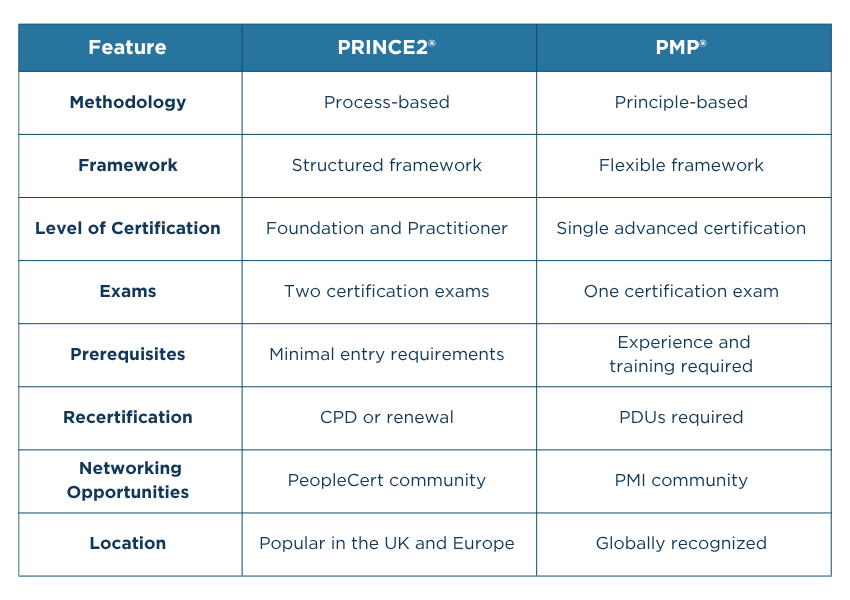
Here are the key differences in the PMP vs PRINCE2 comparison:
1) Methodology
PRINCE2 is a process-based Project Management methodology that guides projects through clearly defined stages, roles, and governance. It provides a structured way to plan, monitor, and control projects from start to finish.
PMP is based on PMI's Project Management principles and the PMBOK® Guide. It enables Project Managers to use predictive, Agile, or hybrid approaches depending on project needs across diverse industries worldwide.
2) Framework
PRINCE2 follows a structured framework built around seven principles, seven practices, and seven processes. This ensures consistency and clear governance throughout the project lifecycle.
PMP uses a flexible framework based on Project Management principles and performance domains. It allows professionals to adapt their approach across different industries, organizations, and project environments.
3) Level of Certification
PRINCE2 offers multiple certification levels, starting with Foundation and progressing to Practitioner. This allows professionals to build their knowledge and apply the methodology at an advanced level.
PMP is a single advanced-level certification intended for experienced Project Managers. It validates both practical Project Management experience and professional knowledge across a wide range of industries.
4) Exams
PRINCE2 includes separate Foundation and Practitioner exams. The Foundation exam tests knowledge of the methodology, while the Practitioner exam assesses the ability to apply PRINCE2 in real project scenarios.
PMP requires candidates to pass one comprehensive exam covering people, processes, and the business environment. The exam focuses on applying Project Management concepts through practical, scenario-based questions.
5) Prerequisites
PRINCE2 Foundation has no formal prerequisites, making it suitable for beginners. However, candidates must hold a recognized PRINCE2 or equivalent certification before taking the Practitioner exam.
PMP has stricter eligibility requirements. Candidates must meet specific Project Management experience and education criteria before they can apply for the certification exam and become eligible to sit for it.
6) Recertification
PRINCE2 Certifications can be maintained by renewing through PeopleCert's certification renewal process or by earning Continuing Professional Development (CPD) points to keep the credential current.
PMP Certification holders must earn Professional Development Units (PDUs) during each certification cycle. This ensures they continue developing their Project Management knowledge and skills.
Strengthen your Agile Project Management skills with industry-recognized
PMI-ACP® Certification Training
– Join today!
7) Networking Opportunities
PRINCE2 professionals can connect with peers through PeopleCert's learning community and accredited training organizations. These networks support continuous learning and professional development.
PMP Certification holders benefit from a global professional network through the Project Management Institute (PMI). They can also participate in local chapters, events, and industry conferences.
8) Location
PRINCE2 is widely recognized across the UK, Europe, Australia, and many Commonwealth countries. It is especially popular within government departments and public sector organizations.
PMP has strong global recognition and is widely valued across North America, Asia, the Middle East, and multinational organizations. It is often preferred by professionals seeking international Project Management opportunities.
Benefits of Getting a PRINCE2® vs PMP® Certification
Both PRINCE2® and PMP® Certifications help professionals strengthen their Project Management capabilities and improve career prospects. While PMP® focuses on broad Project Management competencies across industries, PRINCE2® emphasizes a structured methodology for delivering projects with greater control and consistency.
Benefits of PMP® Certification
Below are some of the key benefits of PMP Certification:
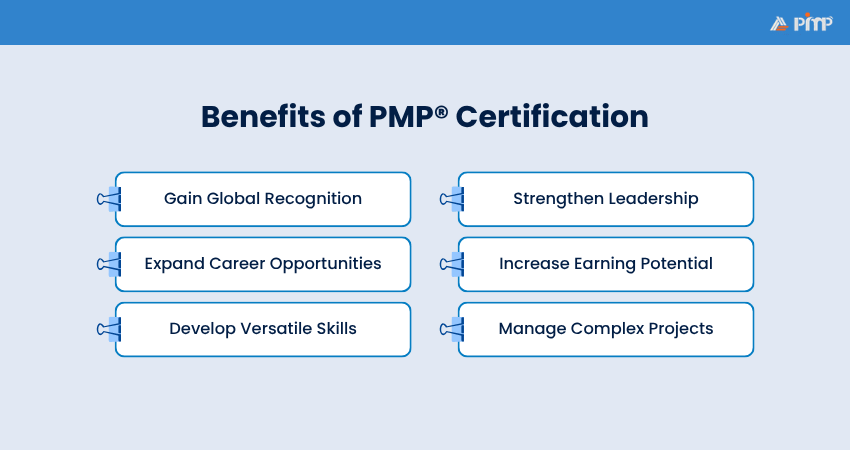
1) Gain Global Recognition:
Earn a credential respected by employers across industries worldwide.
2) Expand Career Opportunities:
Qualify for senior Project Management and leadership roles.
3) Develop Versatile Skills:
Learn predictive, Agile, and hybrid Project Management approaches.
4) Strengthen Leadership:
Improve stakeholder management, communication, and decision-making.
5) Increase Earning Potential:
Enhance your value in a competitive job market.
6) Manage Complex Projects:
Build the confidence to lead projects of varying sizes and complexity.
Benefits of PRINCE2® Certification
Below are the key benefits of earning a PRINCE2® Certification:
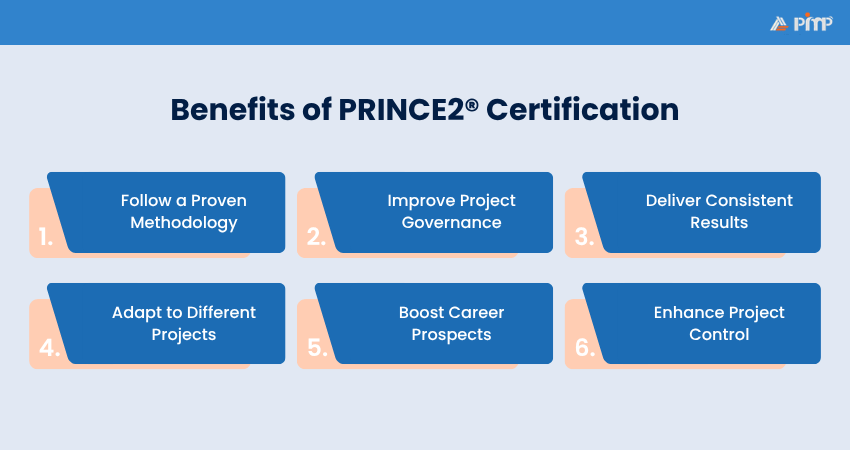
Follow a Proven Methodology: Learn a structured approach to managing projects effectively.
Improve Project Governance: Establish clear roles, responsibilities, and accountability.
Deliver Consistent Results: Apply standardized processes throughout the project lifecycle.
Adapt to Different Projects: Tailor the methodology to suit various industries and project sizes.
Boost Career Prospects: Increase opportunities in the UK, Europe, and public sector organizations.
Enhance Project Control: Improve planning, monitoring, and risk management for successful delivery.
Prepare for Project Management success with the best Certified Associate in Project Management (CAPM) ® Training- Register now!
PRINCE2 vs PMP Certification: Which is More Challenging?
The difficulty of PRINCE2 and PMP depends on your Project Management experience, career goals, and familiarity with project delivery approaches. Neither certification is inherently harder than the other. PRINCE2 follows a structured, process-based methodology, making it a suitable starting point for beginners who want to learn Project Management frameworks and processes.
PMP is designed for experienced Project Managers and requires prior Project Management experience. Its exam covers predictive, Agile, and hybrid approaches, along with leadership, stakeholder management, and scenario-based problem-solving. While PRINCE2® Foundation is generally easier for beginners, PMP is often considered more challenging because of its experience requirements and broader exam content.
Tips for Choosing Between PRINCE2® and PMP® Certifications
Choosing between PRINCE2 and PMP starts with understanding the key differences in the PMP vs PRINCE2 comparison. Your experience, career goals, and the skills you want to develop all play an important role. Evaluating these factors can help you select the certification that best aligns with your professional aspirations and learning needs.
1) Assess Your Experience Level:
Your current Project Management experience should guide your choice. PRINCE2® Foundation is suitable for beginners and those new to Project Management, while PMP is designed for professionals with several years of Project Management experience.
2) Identify Your Learning Goals:
Think about the skills you want to develop. PRINCE2 focuses on structured processes, governance, and project frameworks, whereas PMP covers a broader range of Project Management knowledge, tools, and best practices.
3) Consider Your Career Location:
The value of each certification can vary by region. PRINCE2 is widely recognized in the UK, Europe, and Australia, while PMP is highly valued in the United States, Canada, the Middle East, and many global organizations.
4) Evaluate Your Timeline:
Consider how quickly you want to become certified. PRINCE2® Foundation has no formal prerequisites, making it quicker to achieve. PMP requires specific education and Project Management experience, so the certification process generally takes longer.
5) Consider Earning Both Certifications:
If you want a broader skill set, earning both certifications can be beneficial. PRINCE2 provides a structured Project Management framework, while PMP strengthens your knowledge of Project Management principles and techniques, making you a more versatile Project Manager.
Conclusion
Choosing between PMP vs PRINCE2 depends on your career goals, industry, and experience level. PMP offers broader applicability across industries, while PRINCE2 provides a more structured approach. Both certifications have their advantages, so understanding their key differences will help you make an informed decision. Whichever path you choose, you'll be one step closer to mastering the art of Project Management.
Develop industry-recognized Project Management skills with the Project Management Institute (PMI)® Certification Training – Join now!


 Back
Back

 Topics

 Courses


 10 Aug 2026
 Veronica Davis